

What Is AI Candidate Screening?
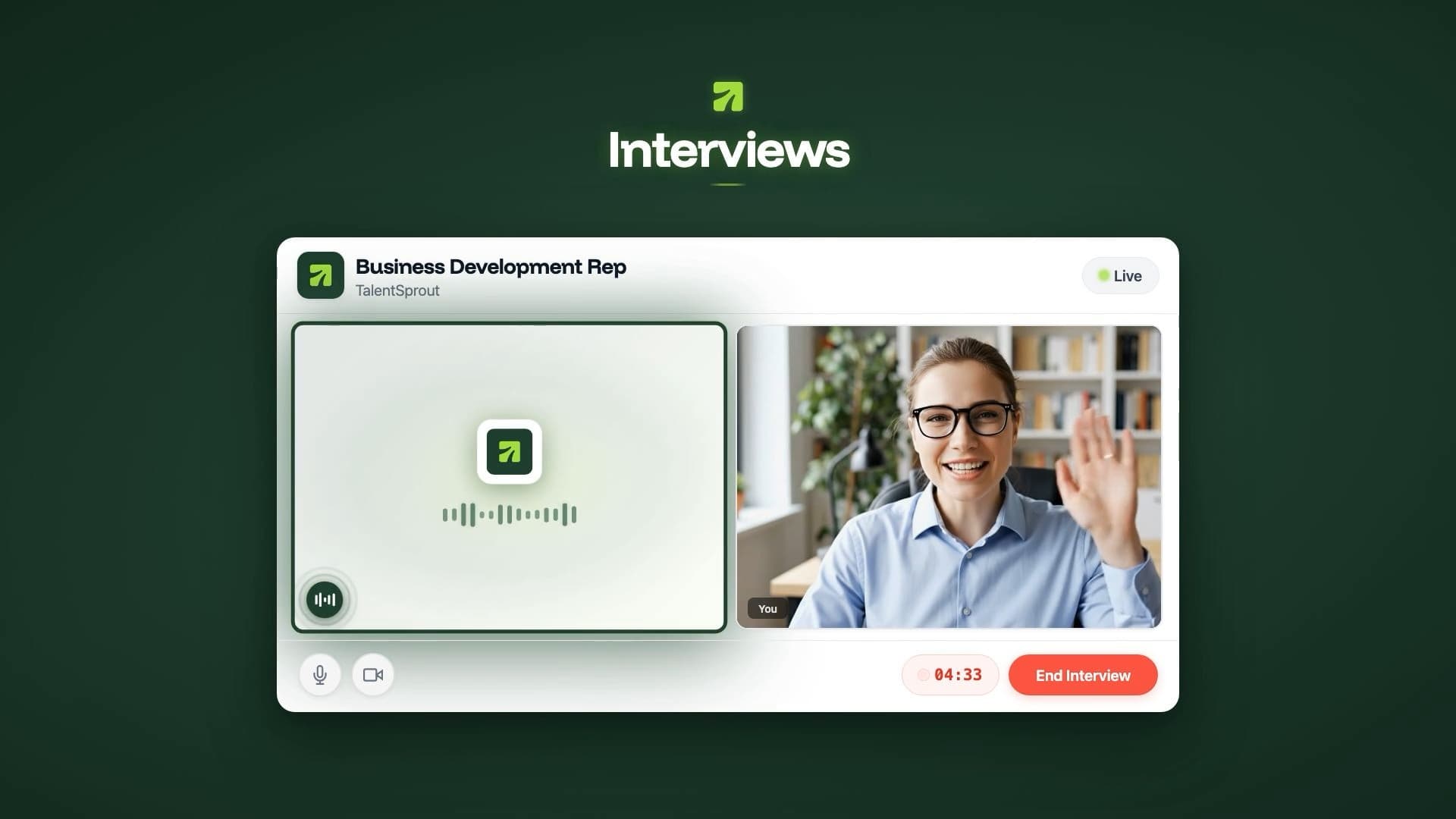
AI candidate screening is the use of artificial intelligence to conduct first-round screening interviews—asking role-specific questions, evaluating responses, and producing structured outputs like scores, summaries, and rankings that help recruiters shortlist faster. Often called a virtual recruiter, this technology replaces the manual phone screen: candidates complete a short automated interview on their own time, and the AI delivers a scored assessment within minutes.
This isn't resume parsing or keyword matching. AI screening tools conduct real conversations—asking follow-up questions, probing for depth, and evaluating soft skills alongside technical knowledge. The output is a structured scorecard that ranks candidates objectively, replacing the gut-feel decisions that plague traditional hiring. For teams evaluating dozens or hundreds of applicants per role, it's the difference between reviewing data and reviewing guesses.
For staffing agencies handling multiple client orders and internal talent acquisition teams managing high-volume pipelines, automated candidate screening compresses what used to take days into hours. The effect is sharpest on repeat-shape roles — call centres, BPO/contact centres, and customer-facing teams — where the same customer service interview questions are asked a thousand times a month and the rubric is what actually predicts retention. AI screening is one layer of a modern staffing software stack — alongside your ATS, CRM, payroll, and communication tools. The result: more placements per recruiter per week, consistent evaluation across every candidate, and structured data your team can actually act on.

How It Differs from Traditional Phone Screening
| Criteria | Traditional Phone Screen | AI Candidate Screening |
|---|---|---|
| Who conducts it | Recruiter | AI (voice or video) |
| Scheduling | Coordinated, prone to no-shows | Candidates complete on their own time |
| Evaluation | Notes in recruiter's head or ATS | Structured scorecard + recording |
| Time per candidate | 15–30 min + scheduling overhead | 6–10 minutes, fully async |
| Scalability | Limited by recruiter headcount | Send to 50+ candidates simultaneously |
| Consistency | Varies by recruiter mood and energy | Same questions, same criteria, every time |
How It Differs from One-Way Video Interviews
One-way video interview tools record candidate answers to static, pre-set questions—the recruiter still watches each video end to end. AI candidate screening is fundamentally different: it conducts a dynamic, conversational interview with intelligent follow-up questions and adaptive flow. The AI evaluates responses against a scoring rubric in real time and produces a structured scorecard. The output is a ranked shortlist with evidence summaries—not a stack of videos your team needs to sit through.
The practical impact matters: one-way video creates more work for recruiters (watching recordings), while automated interview screening eliminates work (reading scorecards). For automated recruiting workflows, this distinction is critical. A tool that generates more content for humans to review isn't automation—it's just a different bottleneck. True recruitment automation means the AI does the evaluation, and the recruiter makes the decision based on structured data. See how TalentSprout's features are designed around this principle.
How AI Candidate Screening Works
The step-by-step workflow from role setup to shortlist review.
Set Up a Role and Scoring Criteria
Define the role, select or write interview questions, and set pass/fail criteria. Choose between voice, video, or both modalities. The scoring rubric ensures every candidate is measured against the same standard.
Send the Interview Link to Candidates
Candidates receive a link via email, SMS, or embedded in a job posting. No app downloads, no scheduling. They complete it when it works for them—nights, weekends, across time zones.
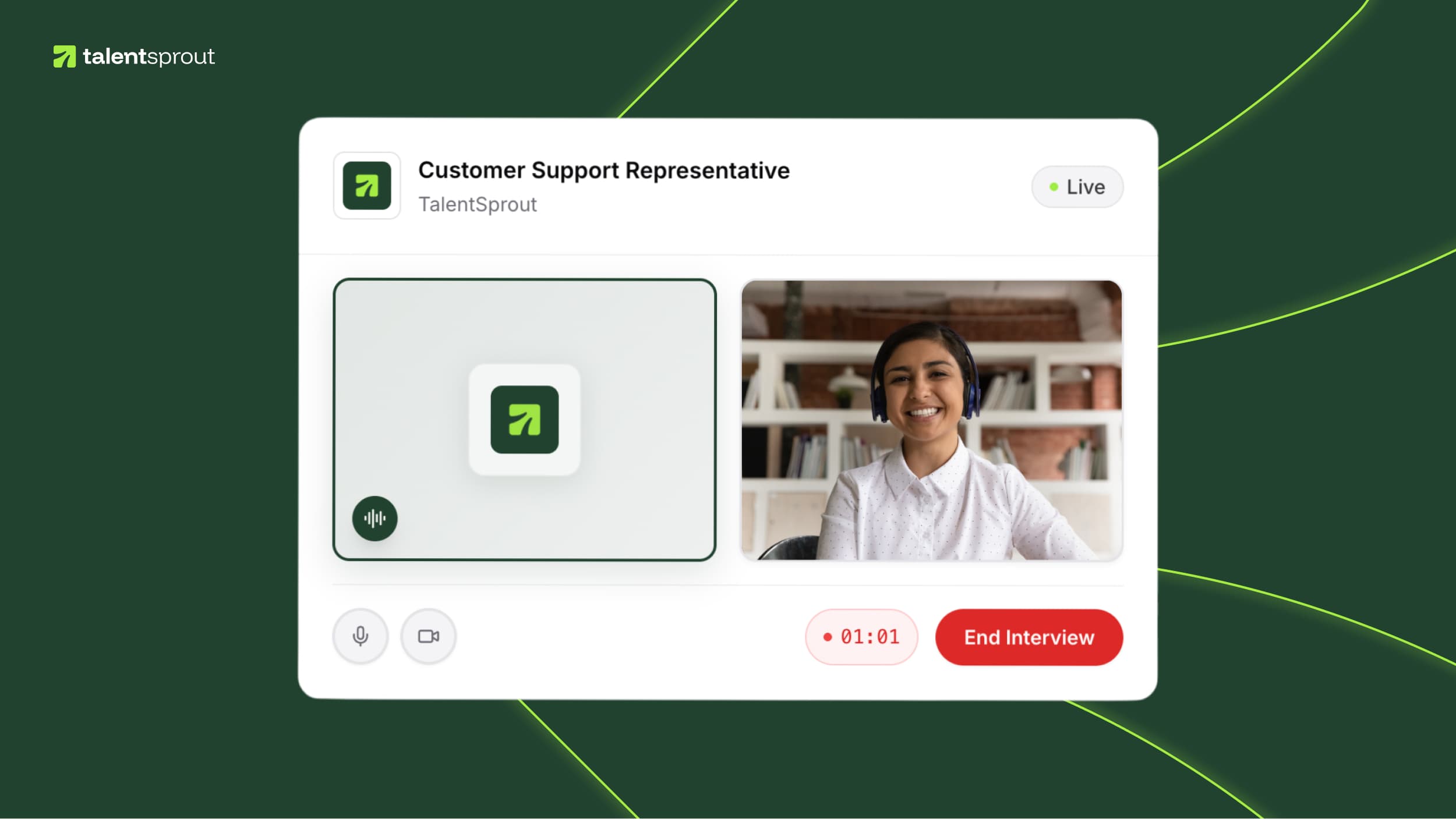
AI Conducts the Interview
The AI asks structured questions, listens to responses, and asks intelligent follow-up questions. It evaluates against your scoring rubric in real time—assessing communication, domain knowledge, and role fit.
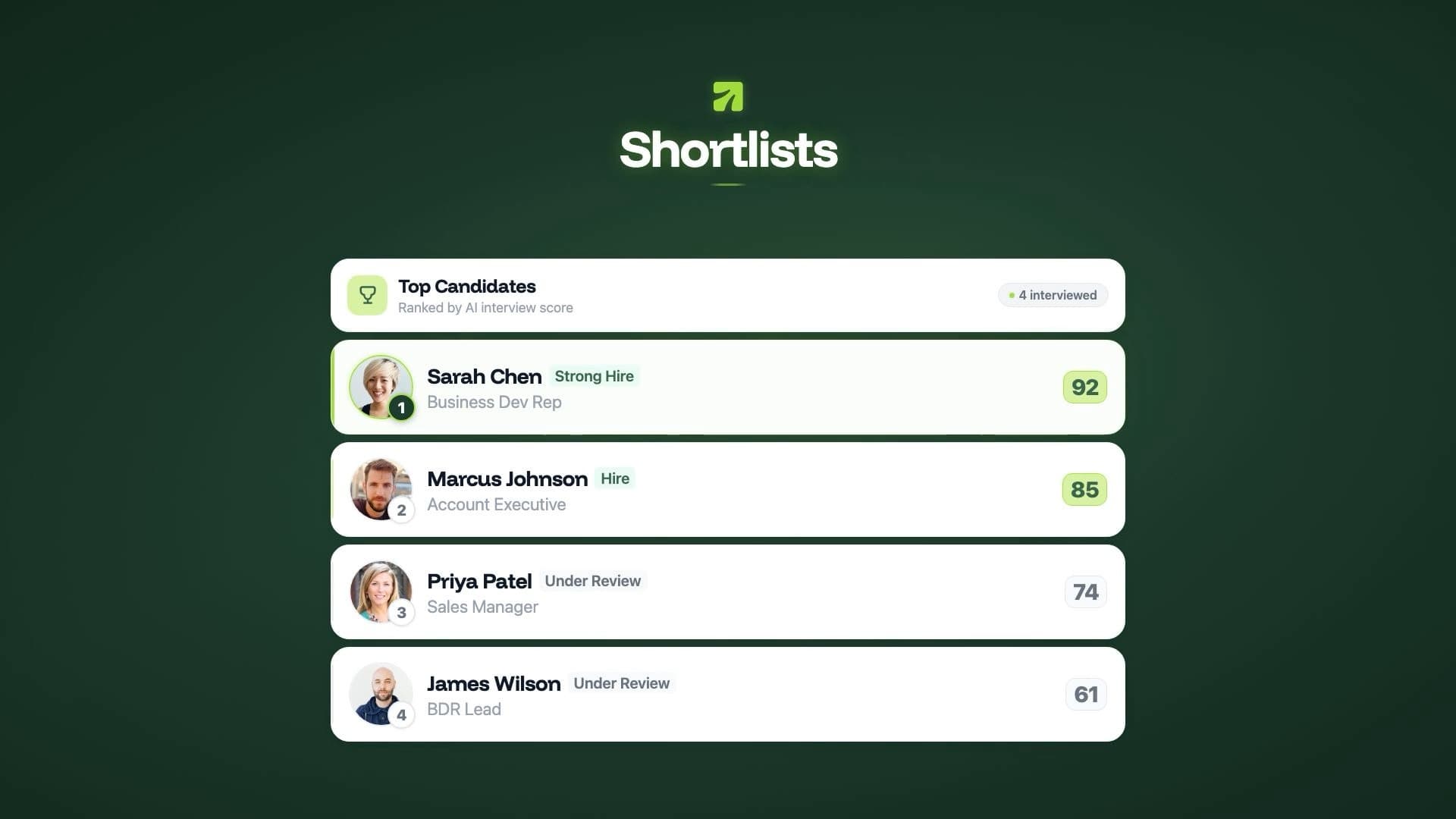
Review Scorecards and Shortlists
Recruiters see a ranked list of candidates with scores, evidence summaries, and links to full recordings and transcripts. The best candidates surface to the top. Shortlist in minutes, not days.
What makes this workflow powerful isn't any single step—it's the end-to-end automation. Traditional automated hiring tools handle fragments: one tool parses resumes, another schedules calls, another tracks candidates. With AI resume screening (or our Resume Screening API if you'd rather embed scoring into your own product) as the first gate and AI interviews as the second, the entire first-round process collapses into a single workflow that runs without recruiter involvement. The candidate applies, completes the automated interview, and the recruiter opens a scored shortlist the next morning.
For a deeper look at each step, see how TalentSprout works. If you're building your own question bank, our guide to strategic interview questions for candidate screening covers 40+ field-tested questions with scoring tips. For a side-by-side look at the platforms that power this workflow, see our comparison of the best AI interviewing tools for staffing agencies. And for what AI can't evaluate on its own — long-term behavior, coachability, and rehire signals — use structured reference check questions on finalists.
Why Staffing Agencies and Recruiters Are Adopting AI Screening
The Recruiter Bottleneck Problem
Staffing agencies juggle multiple client orders simultaneously. Each order requires screening dozens of candidates. The phone-tag loop—leave voicemail, wait for callback, schedule screen, reschedule when they no-show—consumes 40–60% of a recruiter's day. Every day without filling an order is lost revenue, and the math doesn't scale without hiring more recruiters.
The cost is concrete. A recruiter spending 20 minutes per phone screen across 50 candidates per week loses 16+ hours—two full working days—just on first-round screening. At an average recruiter salary, that's $800–$1,200 per week in labor cost for a task that automated candidate screening handles in minutes. Multiply that across a team, and the ROI case for automated recruiting isn't incremental—it's transformational. Time-to-fill drops because candidates are screened the same day they apply, not three days later when half have already accepted other offers.
For recruitment automation to actually work, it needs to compress the screening step without sacrificing the signal recruiters rely on. That means structured evaluation, not just resume parsing. It means qualifying candidates fast, then creating client-submittable candidate packets—scorecards, summaries, evidence—that close placements.
The ROI of Automated Screening (With Real Data)
“With the use of TalentSprout I actually think this might be a good sign because we can turn around role requirements for our clients a lot easier and quicker than we could previously.”
For teams weighing the investment, the math is straightforward: AI screening tools typically cost less per month than a single recruiter's weekly screening hours. TalentSprout includes unlimited interviews on all plans—see current pricing for details.
What to Look for in an AI Candidate Screening Tool
Not all AI screening tools are built the same. Here are the six capabilities that separate tools recruiters love from tools that gather dust. For a detailed side-by-side breakdown, see how TalentSprout compares to HireVue and other enterprise platforms.
Structured Evaluation & Scoring
The tool should produce a scorecard with clear criteria—not just a video to watch. Look for ranked candidate lists, category breakdowns, and evidence summaries that let you compare applicants objectively.
TalentSprout scores candidates 0–100 across customizable criteria with full transcript evidence.
ATS Integration
Results need to flow back into your ATS automatically—Greenhouse, Lever, Bullhorn, Zoho, and others. No swivel-chair data entry, no copy-pasting scores between tabs.
TalentSprout syncs scores, summaries, and scorecard links to your ATS automatically.
Multilingual Support
For global or multilingual hiring, the tool should support the languages your candidates speak. This matters especially for staffing agencies placing candidates in diverse communities.
TalentSprout supports 50+ languages with translated scorecards.
White-Label & Custom Branding
For agencies and platforms, branding control is non-negotiable. Candidates should see your brand throughout the interview experience—not a third-party tool's logo.
TalentSprout offers full white-label branding on all candidate-facing screens.
API & Embed Access
Recruitment platforms and enterprise teams need programmatic interview creation, embeddable widgets, and webhook-driven workflows to integrate screening into existing systems.
TalentSprout provides REST APIs, embed widgets, and webhook support.
Candidate Experience
Candidates should complete interviews on mobile without downloading an app, in under 10 minutes. Completion rates matter—if candidates drop off, the tool isn't helping you fill roles.
TalentSprout interviews are mobile-first, browser-based, and average 6 minutes.
AI Candidate Screening in Practice: Real Results
Case Study: Staffing Agency Screens 140 Candidates in 4 Weeks
The Challenge
A global staffing agency managing high-volume orders across multiple regions needed to screen candidates faster without expanding their recruiting team. Manual phone screens created a multi-week bottleneck—qualified candidates were accepting other offers before recruiters could reach them.
The Solution
The agency deployed AI candidate screening across 7 active roles. Candidates received interview links as part of the application flow and completed structured AI interviews on their own schedule. The platform auto-scored and ranked candidates, delivering shortlists to recruiters each morning.
The Results
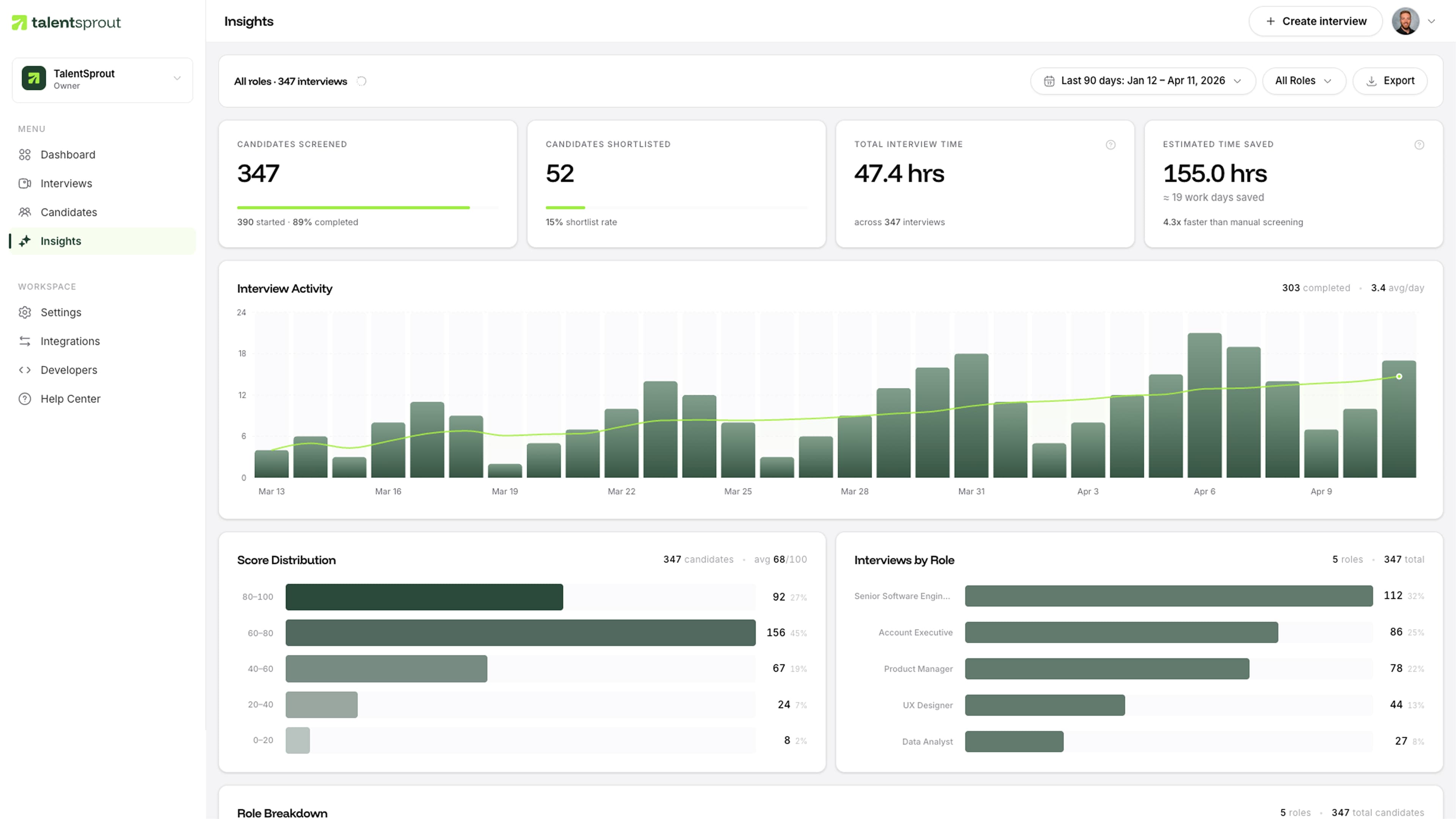
Within 4 weeks, the team screened 140 candidates with 41 auto-shortlisted. Shortlist quality improved from 16% to 43% as the team refined scoring criteria. The platform handled approximately 15 hours of interview time. The team adopted organically—expanding from 4 to 7 roles without being asked.
“This has really helped us, especially in the service analyst role. We didn't speak to the candidates initially—when the candidates applied we already got the shortlisted list of all the resources and we directly forwarded their profiles to the client. There was not a conversation required from our end, so it really saved our time.”
What the Output Actually Looks Like
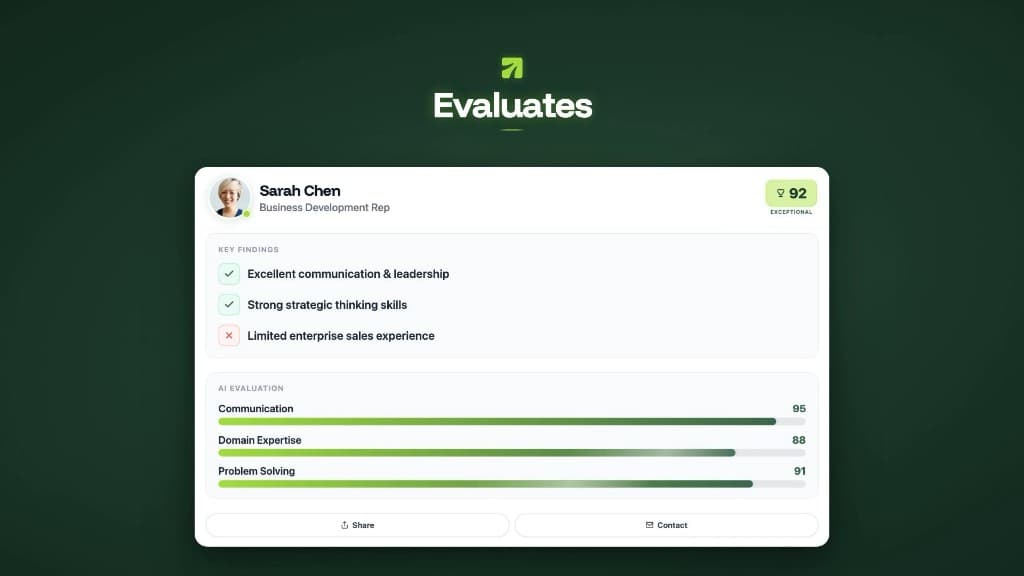
Every AI screening interview produces a structured scorecard — scores, evidence summaries, full transcript, and video recording. Here's a real example.
Key takeaway: AI candidate screening doesn't just save time—it improves shortlist quality. The structured scoring creates a feedback loop: as teams refine criteria, the platform surfaces better candidates faster. Shortlist accuracy nearly tripled in four weeks with zero additional recruiter hours.
Common Concerns About AI Screening
The three questions recruiters ask most before adopting AI candidate screening—answered honestly.
“Will candidates actually do it?”
Real-world data: 140 candidates completed AI screening interviews averaging 6 minutes each—many on nights and weekends. The framing matters: “short automated screening” converts better than “video interview.” Mobile-first, no-download experiences drive high completion rates.
Completion rates are driven by two factors: brevity and accessibility. When an automated interview takes under 10 minutes and works on any phone browser without an app download, candidates treat it like filling out an application—not like preparing for a formal interview. That's why automated candidate screening consistently outperforms scheduled phone screens on reach rate.
“Does AI screening introduce bias?”
Structured, criteria-based evaluation is inherently more consistent than human screening, where recruiter fatigue, time of day, and unconscious preferences affect outcomes. Every candidate gets the same questions and the same rubric. The broader AI bias conversation is real and worth following—but structured AI screening reduces variability compared to manual phone screens.
The key distinction: AI candidate screening tools that evaluate what candidates say (structured responses against a rubric) are fundamentally different from tools that evaluate how candidates look or sound. Criteria-based automated screening focuses on job-relevant signal—domain knowledge, communication clarity, problem-solving approach—not demographic proxies.
For the broader question — whether AI screening replaces the recruiter entirely — see will AI replace recruiters for the data on which recruiting tasks AI actually takes over.
“Is this just one-way video?”
No. AI screening uses adaptive conversation—follow-up questions, response evaluation, real-time scoring. The output is a scored assessment with evidence summaries, not a video the recruiter watches end to end. It's the difference between getting a report and getting a recording.
One-way video is a recording tool. AI candidate screening is an evaluation tool. A modern virtual recruiter adapts in real time—if a candidate gives a vague answer, the AI probes deeper. If they demonstrate strong domain knowledge, it moves on. The result is a scored, evidence-backed assessment that recruiters can act on immediately.
How to Get Started with AI Candidate Screening
Whether you're a staffing agency, recruitment platform, or internal talent team—here's how to start seeing results within your first week. For a broader look at what you can automate beyond screening, see our staffing automation guide.
For Staffing Agencies
Learn more →- Start with 1–2 high-volume roles
- Set up scoring criteria matching client requirements
- Send interview links to your next candidate batch
- Review ranked scorecards the next morning
For Recruitment Platforms
Explore API docs →- Embed AI screening as a native platform feature
- White-label the candidate experience under your brand
- Use the API for programmatic interview creation
- Offer screening as a value-add to your customers
For Internal TA Teams
Start free trial →- Start with a free trial on an active role
- Send 10–20 candidates through the AI interview
- Compare scorecard quality to your current process
- Scale to all open requisitions once validated

From the founder
“We built TalentSprout because we saw recruiters drowning in phone screens — doing the same 15-minute call hundreds of times a week, and still missing great candidates. AI screening isn't about removing the human from hiring. It's about giving recruiters their time back so they can do what actually matters: building relationships and closing placements.”
Frequently Asked Questions
What recruiters and hiring teams ask about AI candidate screening
Most AI screening interviews take 6–10 minutes. Candidates answer structured questions at their own pace, and the AI evaluates responses in real time. The entire process—from opening the link to submitting—is designed to respect candidates' time while gathering the depth of insight recruiters need to make shortlist decisions.
Yes. AI screening interviews are fully mobile-optimized and work in any modern browser—no app download required. Candidates can complete them from their phone, tablet, or computer, wherever they are. This is especially valuable for hourly and shift workers who may not have desktop access during the day.
Leading AI screening platforms support 50 or more languages. Candidates can complete their interview in their strongest language, and recruiters receive translated scorecards and summaries. This removes language barriers from the screening process without requiring bilingual recruiters.
AI scoring evaluates candidate responses against structured criteria you define—communication skills, domain knowledge, problem-solving, cultural fit. It produces a scored assessment that helps recruiters prioritize, but the final hiring decision always stays with your team. Think of it as a consistent first filter, not a replacement for human judgment.
Yes. Most AI screening tools integrate with popular applicant tracking systems like Greenhouse, Lever, Workable, Bullhorn, and Zoho Recruit. Interview scores, summaries, and scorecard links sync directly to the candidate's profile so your team can review results without leaving the ATS.
Reputable AI screening platforms are built with compliance in mind—structured evaluation criteria, consistent question delivery, encrypted data handling, and configurable retention policies. Because every candidate receives the same questions and scoring rubric, AI screening can actually improve consistency compared to manual phone screens. Always verify a vendor's compliance posture for your specific jurisdiction.
One-way video tools record answers to static, pre-set questions—the recruiter still watches each video manually. AI screening conducts a dynamic, conversational interview with follow-up questions, evaluates responses against scoring criteria in real time, and produces a structured scorecard. The output is a ranked shortlist, not a pile of videos.
There's no practical limit. AI screening runs in parallel—you can send interview links to 10 or 500 candidates simultaneously, and each one completes the interview independently. Results come back as candidates finish, so your shortlist builds in real time rather than waiting for a recruiter to work through a call list.
No. AI screening interviews run entirely in the browser. Candidates click a link, grant microphone or camera access, and begin. No app stores, no account creation, no friction. This is a key driver of high completion rates.
Pricing varies by platform and volume. TalentSprout plans start at $199/month and include unlimited AI interviews, scoring, analytics, and branding. Most staffing agencies see ROI within the first week by reclaiming 10–15 hours of recruiter time. Visit our pricing page for current plan details.