

Interview Questions at a Glance
This guide covers 40+ strategic interview questions to ask candidates across six categories. Each question includes why it works and what strong answers sound like. As AI replaces parts of the recruiter workflow, structured rubrics become the recruiter's irreplaceable skill.
| Category | Questions | What It Reveals |
|---|---|---|
| Role & Motivation | 6 | Intent, alignment, genuine interest |
| Problem-Solving | 6 | Critical thinking, adaptability |
| Behavioral | 8 | Past performance, track record |
| Culture & Values | 7 | Working style, team fit |
| Technical & Role-Specific | 6 | Skills, domain knowledge |
| Beyond the Resume | 7 | Self-awareness, growth mindset |
Why Most Interview Questions Fail
The US Department of Labor estimates a bad hire costs 30% of the employee's first-year salary. For a $60,000 role, that's $18,000 in wasted recruiting time, onboarding costs, and lost productivity — before you even start the search over.
Most of those bad hires passed an interview. The problem isn't that interviews don't work — it's that most interviewers ask questions that invite rehearsed answers. “Tell me about yourself” gets a polished elevator pitch. “What's your greatest weakness?” gets a humble-brag. Neither tells you whether this person can actually do the job.
The strategic interview questions to ask candidates in this guide are different. They're designed to surface specific evidence of how candidates think, solve problems, and behave under real conditions. They're harder to rehearse because they require candidates to draw on actual experience — and the best answers reveal patterns of behavior that predict on-the-job performance.
How to Use This Guide
Each question below includes why it works (the strategic reasoning) and what to listen for (concrete signals of strong vs. weak answers). Don't try to ask all 40 in one interview — pick 5–8 from 2–3 categories based on what matters most for the role.
For high-volume screening where you need to evaluate hundreds of candidates with the same strategic questions, AI virtual recruiters can ask these questions at scale and score responses against consistent rubrics — so your team reviews ranked shortlists instead of conducting repetitive first-round calls.
Role & Motivation Questions
These questions reveal whether the candidate wants this job or just any job. Motivation predicts retention better than skills — a motivated hire with a learning curve outperforms a skilled hire who's already looking for the next thing.
1. What specifically about this role made you apply?
Forces candidates past generic answers. Someone who researched the role and can articulate specific appeal is more likely to stay and perform. Vague answers ('I'm looking for new opportunities') signal low intent.
- Specific details about the role description, team, or company
- Connection between their experience and the role's requirements
- Enthusiasm that goes beyond salary or title
2. What would your first 90 days look like if you got this job?
Tests whether candidates can think concretely about the role, not just abstractly. Strong candidates have a plan — even a rough one — because they've thought about what success looks like.
- A structured approach: learn, then contribute, then improve
- Awareness of onboarding realities (they won't 'transform' everything in month one)
- Questions back to you about priorities and expectations
3. What's the most important thing you'd want to accomplish in your first year?
Reveals ambition calibration. Candidates who aim too low may lack drive; those who aim unrealistically high may lack judgment. The sweet spot is ambitious but grounded.
- Goals tied to the actual role, not generic career aspirations
- Understanding of what's realistically achievable
- Alignment with your team's actual priorities
4. How does this role fit into your longer-term career goals?
Retention signal. If the role is a stepping stone to something completely different, you'll lose them in 12 months. If it's a natural progression, you've found alignment.
- A narrative where this role makes logical sense
- Growth aspirations that the role can realistically support
- Honesty about what they want next (not just what you want to hear)
5. What drew you to this industry specifically?
Separates people who chose this field deliberately from those who fell into it. Both can be great hires, but the reasoning reveals values and decision-making patterns.
- A specific moment or experience that sparked interest
- Understanding of the industry beyond surface level
- Genuine curiosity about the space
6. What would make you turn down this offer?
Flips the power dynamic and invites honesty. The answer reveals their actual priorities — compensation, culture, remote work, growth — and lets you address concerns proactively.
- Candid, specific dealbreakers (not 'nothing, I really want this job')
- Priorities that signal self-awareness
- Whether their dealbreakers conflict with your actual offering
Problem-Solving & Critical Thinking Questions
These test how candidates approach novel challenges — not whether they know the “right answer,” but how they think through uncertainty. The process matters more than the outcome.
7. Tell me about a time you had to solve a problem with incomplete information.
Every real job involves ambiguity. This question reveals whether candidates can make progress despite uncertainty or whether they freeze waiting for perfect data.
- A clear framework for gathering what information was available
- Comfort with making decisions under uncertainty
- Awareness of the risks they took and how they mitigated them
8. Walk me through how you'd approach [role-specific scenario].
Customize this to your role. Watching someone think through a realistic problem in real time reveals more than any resume bullet. You're evaluating their process, not their answer.
- Structured thinking: they break the problem into steps
- Questions they ask you for clarification (a sign of thoroughness)
- Awareness of tradeoffs and second-order effects
9. What's the hardest professional problem you've solved? What made it hard?
The 'what made it hard' follow-up is key. It reveals self-awareness about complexity — technical difficulty, stakeholder conflict, ambiguity, time pressure. The nature of the difficulty tells you about their professional maturity.
- Specific, measurable description of the problem
- Honest assessment of what made it challenging
- A clear resolution with lessons learned
10. How do you decide between two imperfect options under time pressure?
Tests judgment, not just intelligence. Strong candidates have a decision framework — even a simple one — while weaker candidates either agonize or pick randomly.
- A described process: weigh tradeoffs, consult stakeholders, decide
- Comfort with 'good enough' when perfect isn't possible
- Examples of when they chose wrong and what they learned
11. Describe a situation where your initial approach didn't work. What did you do?
Adaptability signal. Everyone fails — the question is whether they pivot, escalate, or dig in harder on a failing strategy. The best candidates fail fast and learn faster.
- Quick recognition that the approach wasn't working
- Willingness to change course rather than double down
- What they learned and applied going forward
12. What's something you taught yourself in the last year? How?
Learning agility is the single best predictor of long-term performance. This question reveals whether candidates invest in their own growth or coast on existing skills.
- Something genuinely new, not a refinement of existing skills
- A described learning process (not 'I just figured it out')
- Evidence they applied what they learned
Behavioral & Past Performance Questions
Behavioral questions are the backbone of structured interviews. They ask candidates to describe specific past situations using the STAR method (Situation, Task, Action, Result). Past behavior is the strongest predictor of future performance.
13. Tell me about a time you disagreed with a manager. How did you handle it?
Reveals conflict style and professional maturity. You want someone who pushes back respectfully — not a yes-person, but not a combative contrarian either.
- Respectful framing of the disagreement
- Evidence they presented their case with data, not emotion
- Willingness to commit even if overruled
14. Describe a project where the scope changed mid-way. What did you do?
Tests adaptability in a universal scenario. Every project scope changes — the question is whether they adapted gracefully or resisted, and whether they communicated proactively.
- Proactive communication with stakeholders about the change
- Practical re-prioritization of their work
- A positive or neutral attitude toward the shift
15. What's a professional failure you've learned the most from?
Self-awareness test. Everyone has failures — the signal is whether they can articulate what went wrong, own their part, and describe what changed. Candidates who can't name a failure are either dishonest or lack self-awareness.
- Genuine ownership (not blaming others or circumstances)
- Specific lesson learned, not a generic platitude
- Evidence the lesson actually changed their behavior
16. Give me an example of when you had to influence someone without authority.
Critical for any role that involves cross-functional work. Influence without authority is one of the hardest professional skills — and one of the most valuable.
- Understanding of the other person's motivations and concerns
- A persuasion approach based on shared goals, not pressure
- A successful outcome achieved through collaboration
17. Tell me about a time you had to deliver bad news to a stakeholder.
Communication under pressure reveals character. Strong candidates are direct, empathetic, and solution-oriented. Weak candidates delay, sugarcoat, or blame.
- Timeliness — they didn't wait until the last minute
- Directness paired with empathy
- A proposed solution or next steps alongside the bad news
18. Describe a situation where you went above what was expected. Why?
The 'why' matters more than the 'what.' Intrinsic motivation (they saw a need and acted) is more predictive than extrinsic (they wanted a promotion). This reveals drive and ownership mindset.
- Initiative without being asked
- Motivation rooted in impact, not recognition
- Specific outcomes from the extra effort
19. When was the last time you received critical feedback? What did you do with it?
Coachability is non-negotiable. Candidates who can describe receiving feedback, processing it without defensiveness, and acting on it are exponentially more valuable than those who can't.
- A recent, specific example (not something from 5 years ago)
- Emotional maturity in how they received it
- Concrete actions they took to address the feedback
20. Tell me about a time you had to work with someone difficult.
Every team has friction. This reveals interpersonal skills, empathy, and whether they default to collaboration or avoidance when relationships get hard.
- Empathy for the other person's perspective
- Active effort to find common ground or resolve the tension
- Professional outcome despite personal difficulty
Culture Fit & Values Alignment Questions
Important caveat: “culture fit” doesn't mean “people like us.” It means values alignment and working style compatibility. The goal is to find someone who thrives in your environment — not someone who looks, thinks, and talks exactly like your existing team.
21. What kind of work environment brings out your best performance?
Self-awareness about work style. Someone who thrives in fast-paced chaos will struggle in a methodical, process-heavy organization — and vice versa. Neither preference is wrong; the question is fit.
- Specific descriptions, not vague 'I'm flexible' answers
- Alignment (or honest misalignment) with your actual environment
- Examples from past roles that illustrate the preference
22. How do you prefer to receive feedback?
Reveals communication preferences and emotional maturity. Some people want direct, blunt feedback; others need context and framing. Knowing this upfront prevents management friction.
- A specific preference (not 'any feedback is fine')
- Awareness of how they react to different feedback styles
- Openness to adjusting their preference for the team
23. Tell me about the best team you've ever worked on. What made it work?
People reveal their values when describing what they admire. If they value collaboration, they'll describe teamwork. If they value autonomy, they'll describe independence. The answer tells you what they'll seek in your team.
- Specific dynamics they valued, not generic 'great people'
- Their role in making the team work (not just benefiting from it)
- Values that align with your team's actual culture
24. How do you handle ambiguity or unclear expectations?
Essential for any growing company or startup-stage team. Candidates who need perfect clarity before they act will struggle in fast-moving environments. Those who thrive in ambiguity bring disproportionate value.
- Comfort with asking clarifying questions rather than waiting
- Ability to make reasonable assumptions and move forward
- Track record of creating structure where none existed
25. What does "doing a good job" look like to you?
Reveals personal performance standards. Some people define success by hitting targets; others by team outcomes; others by learning and growth. None is wrong — but alignment with your expectations matters.
- Concrete, measurable definitions (not 'giving 110%')
- Alignment with how your organization measures success
- Intrinsic standards beyond external metrics
26. What would a former colleague say is your biggest strength? Your biggest area for growth?
The third-person framing often yields more honest answers than 'What are your strengths?' People are more candid when attributing the assessment to someone else.
- Consistency between their self-assessment and what references would say
- A genuine growth area, not a disguised strength
- Evidence of working on the growth area
27. Describe your ideal manager.
Tells you whether your management style will work for this person. If they want hands-off autonomy and you're a hands-on coach (or vice versa), you'll both be frustrated within months.
- Specific management behaviors they value
- Alignment with the actual manager's style
- Flexibility — can they adapt if the fit isn't perfect?
Technical & Role-Specific Questions
These should be customized for every role. The framework below gives you adaptable templates — replace the bracketed sections with specifics from the job description.
28. Walk me through [specific task relevant to the role] from start to finish.
The most direct test of competency. Asking someone to narrate a task step-by-step reveals depth of knowledge, shortcuts they've learned, and gaps they might be hiding.
- Logical sequence that matches real-world execution
- Mention of edge cases or potential problems
- Efficiency and best practices baked into their approach
29. What tools or systems have you used for [core role function]?
Beyond the tool names, listen for how they describe their proficiency. 'I used Salesforce' is surface-level. 'I built custom reports and automated our pipeline tracking' shows real capability.
- Specific tools with described depth of use
- Adaptability across different tools and platforms
- Self-taught proficiency vs. formal training
30. How do you stay current in [field/technology]?
Reveals continuous learning habits. In fast-moving fields, someone who stopped learning 2 years ago is already outdated. In stable fields, this reveals intellectual curiosity.
- Specific sources: publications, communities, courses
- Evidence of applying new knowledge to their work
- Genuine curiosity, not performative learning
31. What's the most complex [role-specific deliverable] you've produced?
Complexity calibration. Their definition of 'complex' tells you about their experience level. A senior hire's 'complex' should be meaningfully harder than a mid-level hire's.
- Specific description of the deliverable and its complexity
- Their role in creating it (individual contributor vs. coordinator)
- Outcome and stakeholder reception
32. If you were training someone on [key skill], what would you cover first?
Teaching ability reveals depth of understanding. If someone can explain a skill clearly to a beginner, they understand it at a fundamental level — not just a procedural one.
- A structured teaching approach (foundations first, then complexity)
- Awareness of common mistakes or misconceptions
- Patience and clarity in their explanation style
33. What metrics do you use to measure your own performance?
Self-accountability signal. People who track their own performance tend to outperform those who wait for external evaluation. The specific metrics they choose reveal what they value.
- Specific, measurable metrics (not 'I try my best')
- Both quantitative and qualitative measures
- Alignment with how your organization measures the role
Customizing Questions by Role Type
For a role-specific deep dive, see our guide to customer service interview questions — 18 questions across 5 categories with a scoring rubric built for call centres, BPO contact centres, and high-volume hiring.
| Role Category | Customize Around | Example Question |
|---|---|---|
| Customer Service | De-escalation, empathy, multi-tasking | “Walk me through how you'd handle an upset customer who received the wrong order.” |
| Technical / IT | Troubleshooting, system knowledge | “Describe your approach to diagnosing a production issue you've never seen before.” |
| Sales | Objection handling, pipeline mgmt | “Tell me about a deal you lost and what you learned from it.” |
| Healthcare | Patient interaction, compliance | “How do you handle competing urgent requests from multiple patients?” |
| Management | Delegation, coaching, conflict | “How do you handle an underperforming team member?” |
Questions That Reveal What Resumes Can't
These are the “secret weapon” questions that go beyond credentials and experience. They surface self-awareness, growth mindset, and the qualities that actually predict whether someone will thrive on your team.
34. What's something you're great at that wouldn't show up on your resume?
Invites candidates to showcase hidden strengths — communication skills, mentoring ability, crisis management, creative thinking. Often surfaces the most authentic answers in the entire interview.
- Something genuinely valuable, not trivial
- Evidence to back the claim (not just 'I'm a great communicator')
- Self-awareness about strengths beyond their job title
35. Tell me about a time you had to learn something completely outside your expertise.
Learning agility in unfamiliar territory. This is different from Question 12 — it specifically tests willingness to step outside their comfort zone entirely, not just refine existing skills.
- Genuine discomfort that they pushed through
- A systematic approach to learning the unknown
- Application of the new knowledge to achieve a result
36. What's the biggest misconception people have about you professionally?
Self-awareness and emotional intelligence test. The answer reveals how they think others perceive them — and whether they've done the work to understand the gap between perception and reality.
- A specific misconception they've identified
- Understanding of why the misconception exists
- What they do (or don't do) to address it
37. If you could redesign your current or last role, what would you change?
Reveals whether they think critically about process, not just execute within it. Candidates who can articulate improvements show initiative, systems thinking, and ownership.
- Specific, actionable changes (not vague complaints)
- Understanding of why the role is structured the way it is
- Improvements that would benefit the team, not just themselves
38. What questions do you have for me?
This might be the most important question in the interview. The quality of a candidate's questions reveals more about their judgment, preparation, and genuine interest than any answer they give.
- Questions about the role, team, and challenges — not just perks
- Evidence of research about your company
- Thoughtful follow-ups to what was discussed during the interview
39. What's something you're actively working on improving?
Growth mindset signal. The best hires are always working on something. If they can't name a current area of improvement, they may have plateaued — or lack the self-awareness to identify gaps.
- A current, in-progress effort (not something they worked on years ago)
- Specific actions they're taking to improve
- A realistic assessment of their progress
40. Where would you push back on how things are done here?
Tests intellectual honesty and willingness to challenge constructively. You want someone who'll improve your team, not just conform to it. The caveat: they need enough context to push back intelligently.
- Thoughtful observations, not reflexive criticism
- Questions to understand before suggesting changes
- Respect for existing processes while advocating for improvement
How AI Is Changing Candidate Screening
These 40 questions are powerful — but they have a scaling problem. No recruiter can ask 8 strategic questions to 200 applicants. At a staffing agency managing 20 requisitions across 5 clients, the math breaks down fast: you either cherry-pick resumes and skip most applicants, or you burn out your team on repetitive phone screens. Combining AI resume screening with strategic interview questions solves both halves of the problem: the AI filters resumes first, then asks the right questions to the right candidates.
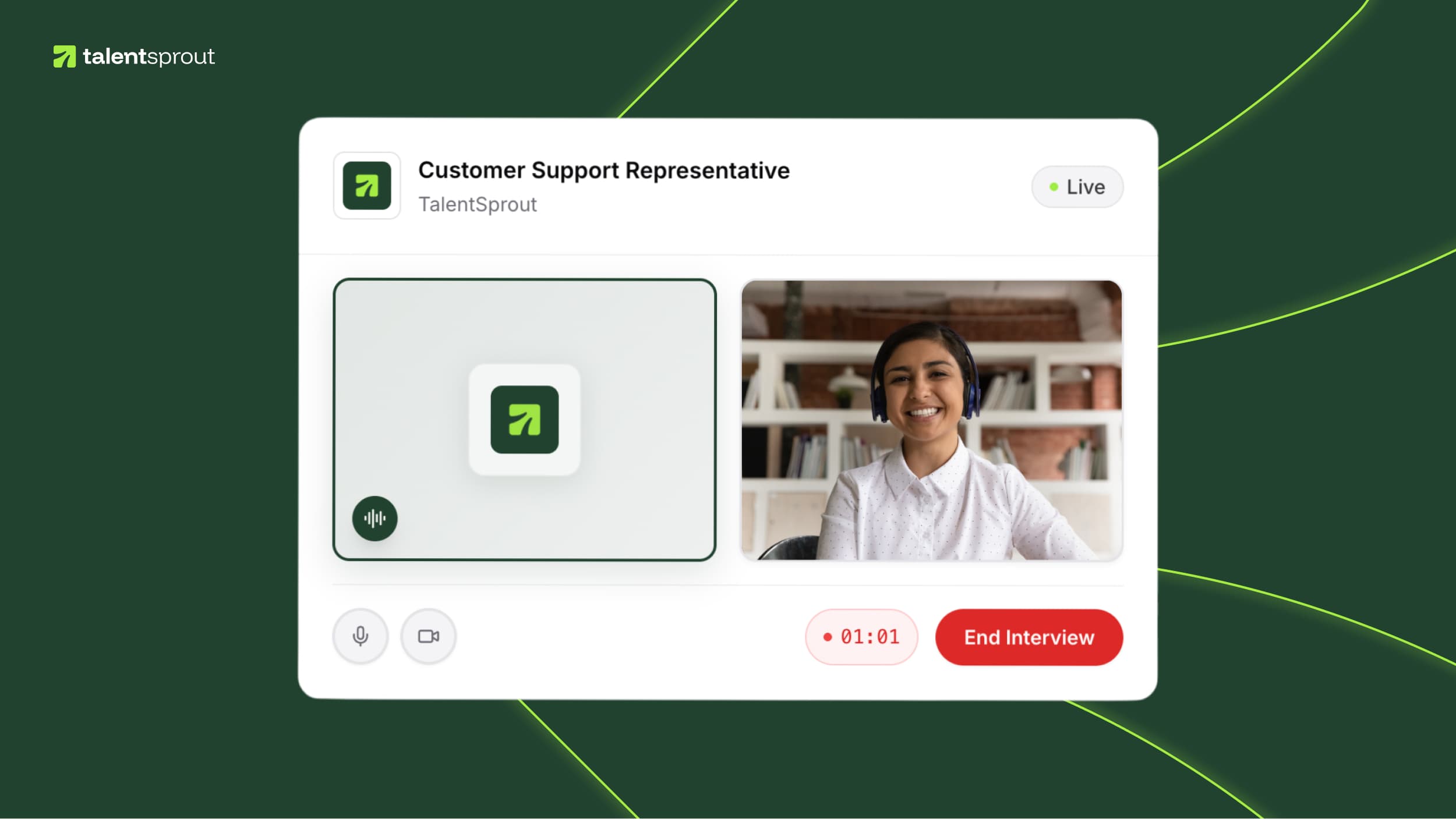
That's where AI candidate screening changes the equation. Modern AI screening tools can ask these same strategic questions to every applicant simultaneously — via voice, video, or both. The AI evaluates responses against structured rubrics (the same scoring criteria your team would use) and produces ranked shortlists with evidence summaries for each candidate.
When RVS iGlobal, an IT outsourcing firm, replaced their first-round phone screening with automated candidate screening, they screened 140 candidates across 7 roles in 4 weeks. Shortlist quality improved from 16% to 43% as the team refined scoring criteria. The platform handled approximately 15 hours of screening interviews — time the team reinvested in client relationships and closing placements.
Full disclosure: TalentSprout is our product. We believe AI screening complements — not replaces — thoughtful interview questions. The strategic questions in this guide are valuable whether you use AI screening or not.
Scoring Framework: How to Evaluate Responses
Good questions are only half the equation — you also need a consistent way to evaluate the answers. This 1–5 scoring rubric gives your team a shared language for assessing candidate responses. Use it immediately after each question, not at the end of the interview when memory fades.
Before you start interviewing, calibrate with your team. Pick 2–3 questions and agree on what a “4” looks like versus a “3.” This alignment eliminates the biggest source of scoring inconsistency across interviewers.
| Score | Label | Definition |
|---|---|---|
| 5 | Exceptional | Specific examples with measurable outcomes; demonstrates a pattern of excellence |
| 4 | Strong | Clear examples with context; shows consistent competency in the area |
| 3 | Adequate | General answers with some specifics; meets baseline expectations |
| 2 | Developing | Vague or hypothetical answers; limited evidence of hands-on experience |
| 1 | Concerning | No relevant examples; deflects, contradicts, or raises red flags |
AI screening tools apply this same consistent scoring across every candidate automatically — eliminating the variability that comes from different interviewers, different times of day, and different energy levels. For a deeper look at how automated scoring works, see our complete guide to AI candidate screening.
After the interview, complete your evaluation with a structured reference call. Our guide to the 10 essential reference check questions uses the same scoring framework above — so interview and reference signals combine into one consistent evaluation.
Frequently Asked Questions
Common questions about interview questions, structured interviewing, and AI-assisted screening
Plan for 5–8 strategic questions per 30-minute interview. Fewer questions with deeper follow-ups reveal more than rushing through 15 surface-level prompts. Pick questions from 2–3 categories based on what matters most for the role — don't try to cover all six categories in one session.
Behavioral questions ask about past experiences ('Tell me about a time you…'), while situational questions pose hypothetical scenarios ('How would you handle…'). Behavioral questions are generally more predictive because past behavior is the best indicator of future performance. Use situational questions when candidates lack directly relevant experience.
Yes — for the same role. Structured interviews where every candidate answers the same core questions are significantly more predictive than unstructured conversations. This also protects against bias by ensuring consistent evaluation criteria. You can add 1–2 role-specific follow-ups, but the core set should stay constant.
Use structured questions with predefined scoring rubrics. Ask every candidate the same questions in the same order. Score responses immediately after each question, not at the end. Avoid questions about personal life, family status, or anything unrelated to job performance. Calibrate scoring with your team before interviews begin.
Avoid questions about age, marital status, religion, national origin, disability, pregnancy, or arrest history — these are legally protected categories in most jurisdictions. Also avoid generic questions like 'What's your greatest weakness?' or 'Where do you see yourself in 5 years?' — they invite rehearsed answers and reveal little about actual capability.
AI screening tools can ask these same strategic questions to hundreds of candidates simultaneously, evaluate responses against structured rubrics, and produce scored shortlists — so recruiters spend time reviewing top candidates instead of conducting repetitive first-round screens. This is especially valuable for high-volume hiring where manually interviewing every applicant isn't feasible.
Focus on motivation, learning ability, and problem-solving — not experience they don't have yet. Questions like 'What's something you taught yourself recently?' and 'How do you approach a task you've never done before?' reveal potential better than 'Tell me about your 5 years of experience.' The Role & Motivation and Beyond the Resume categories in this guide work especially well for entry-level roles.