

Will AI Replace Recruiters? The Short Answer
AI will not replace recruiters. It will replace a specific slice of the recruiter workflow — the repetitive, high-volume, pattern-matching parts — and push human hours toward the parts of the job that always mattered most: hiring-manager partnership, candidate closing, and client strategy.
The trend is already measurable. SHRM's 2025 research reports 51% of organizations now use AI in hiring, up from 26% the prior year. McKinsey's Superagency report finds 78% of organizations use AI in at least one business function — hiring is one of the fastest adopters.
The framing that matters isn't replacement; it's redistribution. When AI candidate screening takes over first-round evaluation, recruiter capacity doesn't disappear — it moves upstream. Staffing agencies, IT outsourcers, and BPOs process candidates 4x faster than manual screening. The team doesn't shrink; the work shifts.
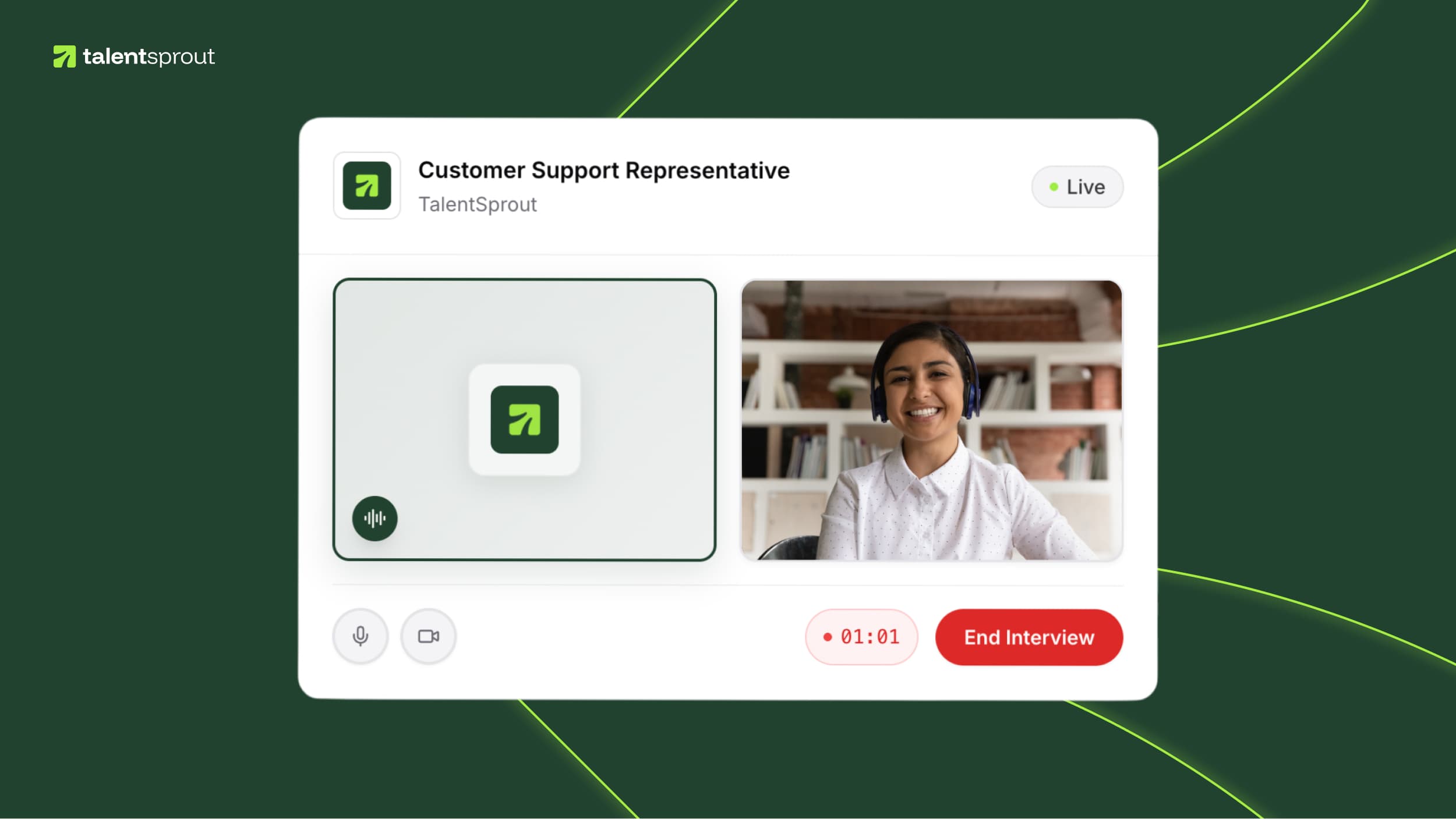
What “AI replaces the task” actually looks like — a candidate completing a structured TalentSprout AI interview while the recruiter's calendar stays clear.
A Week in the Life of a High-Volume Recruiter
Whether you run a staffing agency, an IT outsourcing firm, or a BPO recruiting desk, the week breaks down roughly like this. The table below shows a typical 40-hour week, alongside how much of each task is automatable with 2026-generation AI. HR Dive reports the average recruiter spends 7.4 seconds on each resume — evidence that resume screening, in particular, is already a pattern-match task more than a judgment one.
| Task | Hrs / week | Automatable today? | How it plays out |
|---|---|---|---|
| Resume screening | 6 | Fully | Scored by AI in seconds per resume |
| First-round phone screens | 5 | Fully | Replaced by async AI interviews |
| Interview scheduling & coordination | 3 | Fully | Calendar automation plus AI handoff |
| Candidate status updates | 1 | Fully | Triggered from ATS status changes |
| Pipeline reporting & ATS hygiene | 1 | Fully | Generated from the source of truth |
| Candidate sourcing & outreach | 4 | Partially | AI drafts, human picks and approves |
| Structured skills interviews | 4 | Partially | AI runs depth, human runs judgment |
| Reference checks | 2 | Partially | AI narrows, human calls managers |
| Hiring manager intake & calibration | 4 | Human | Human |
| Client check-ins & relationship calls | 4 | Human | Human |
| Offer negotiation & closing | 3 | Human | Human |
| Team stand-ups & pipeline strategy | 3 | Human | Human |
← Scroll to see full week →
The math behind the 40% claim
Of the 40 recruiter-hours in this table, 16 are fully automatable today and another 10 are partially automatable. Sixteen out of forty is the 40% figure cited above. The remaining 14 hours — hiring-manager intake, client calls, offer closing, pipeline strategy — stay human, because they require context and accountability that current AI doesn't hold.
Which Tasks AI Can and Can't Do
The replacement debate ignores that recruiting has always been a bundle of tasks, not a single job. Three years into mainstream AI in recruiting, today's systems own some of those tasks outright, handle others with human oversight, and simply can't replicate the rest.
| Capability | AI today | Human required |
|---|---|---|
| Resume scoring against a rubric | Yes | No |
| Structured skills interviewing | Yes | Partial |
| Scoring communication, domain, problem-solving | Yes | No |
| Scheduling, status updates, ATS hygiene | Yes | No |
| Long-term behavioral pattern verification | Partial | Yes |
| Hiring-manager calibration & intake | No | Yes |
| Offer negotiation & closing | No | Yes |
| Judgment on borderline candidates | Partial | Yes |
| Client relationship & account strategy | No | Yes |
What AI handles today
- Structured interviews across TalentSprout's five evaluation dimensions — Communication Skills, Domain Expertise, Problem Solving, Cultural Fit, and Professionalism.
- Resume scoring at scale — see how AI resume screening replaces the 7.4-second scan with a rubric that actually holds across a pipeline.
- Scheduling, status updates, and async candidate communications that used to chew up a recruiter's Monday mornings.
- Consistent scorecards that remove interviewer bias and produce comparable data across candidates.
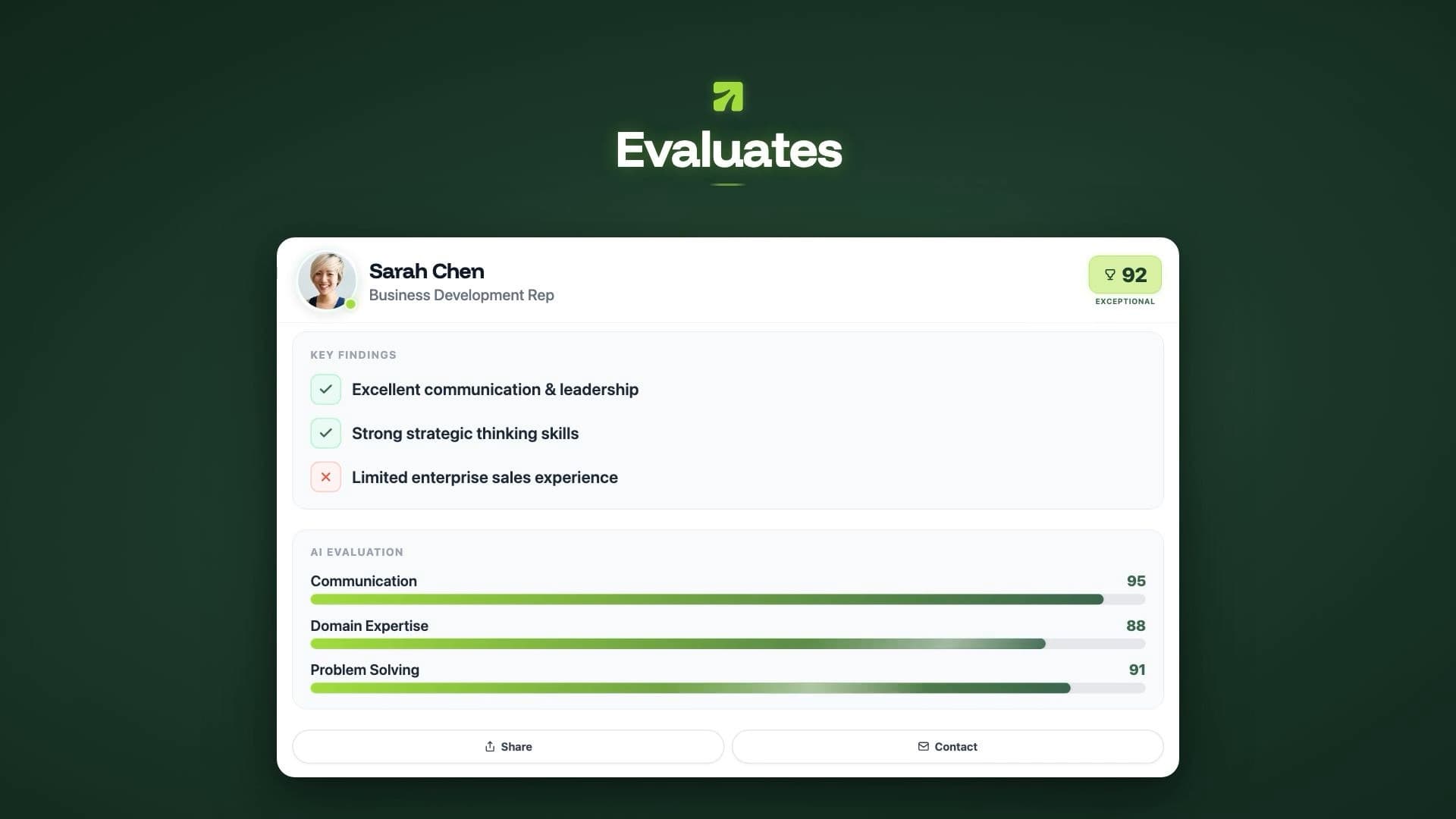
The five-dimension scorecard AI runs today — Communication Skills, Domain Expertise, Problem Solving, Cultural Fit, and Professionalism.
Where humans stay essential
According to Demandsage's AI recruitment research, 93% of recruiting leaders say human involvement remains essential to the hiring process. These are the tasks they mean:
- Hiring-manager intake and calibration — translating a role description into an actual scorecard.
- Offer negotiation and closing — where trust, timing, and candidate psychology decide outcomes.
- Client relationship management and account strategy for staffing agencies and outsourcers.
- Judgment on borderline candidates — the ones the AI ranks in the middle of the pile.
The gray zone
- Reference checks — AI narrows the pool to finalists, but the reference check questions that reveal long-term behavior still need a human on the phone.
- Candidate sourcing — AI drafts outreach and surfaces profiles; recruiters still decide who's worth a conversation.
- Structured depth interviews — AI runs the rubric-scored first round; humans run the second-round judgment call.
What the Data Shows: A Live Deployment
Full disclosure: TalentSprout builds AI screening software. The iGlobal numbers below are from one of our live deployments — we're citing them because they're specific and verifiable. Every external stat in this piece links to a primary source.
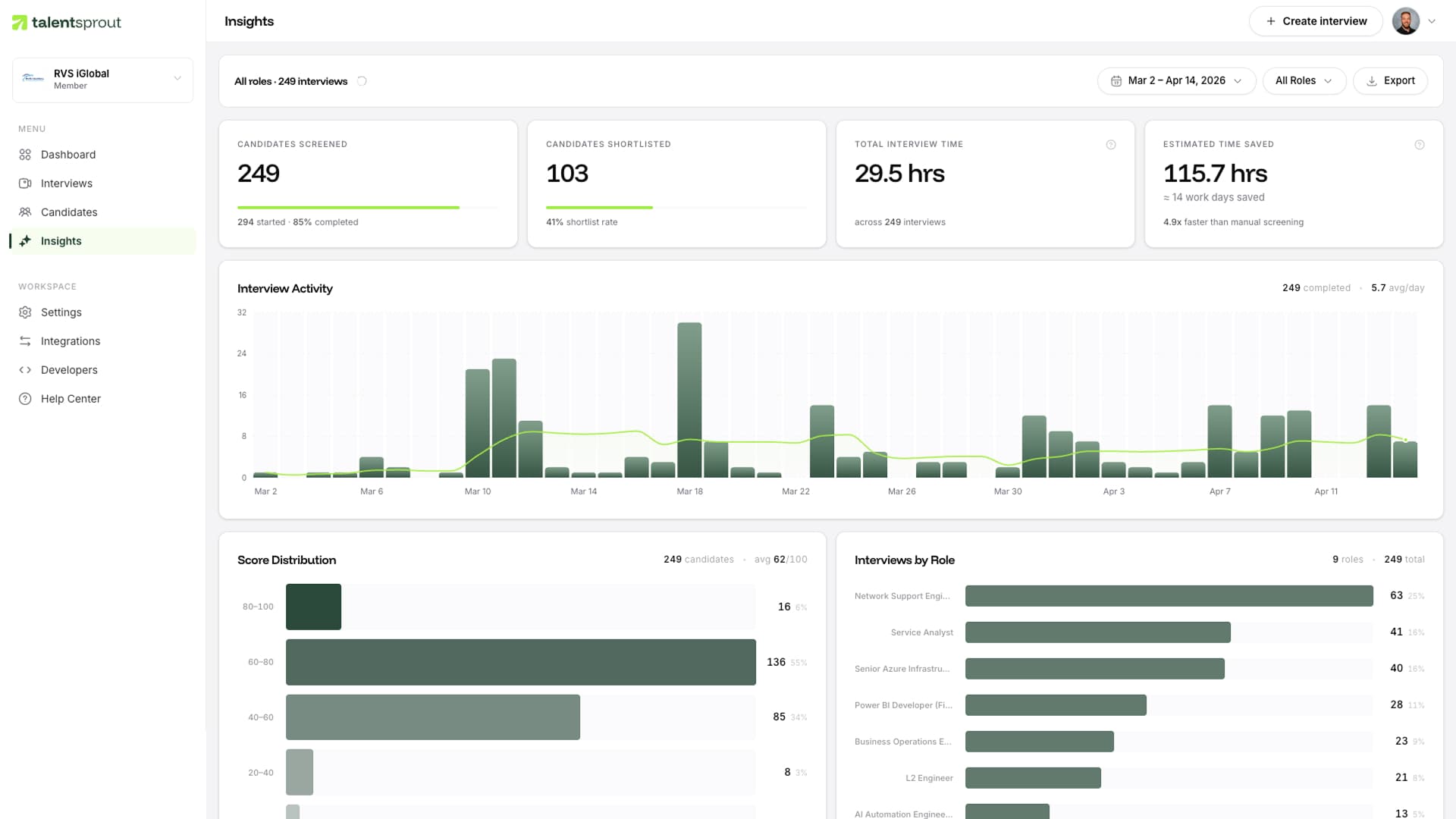
RVS iGlobal's live TalentSprout insights dashboard — 248 candidates, 103 auto-shortlisted, across 9 technical IT roles.
RVS iGlobal — a global white-label IT services provider
248 candidates, 9 technical IT roles, 6 weeks.
- 248 candidates screened across 9 technical IT roles
- 103 auto-shortlisted — a 42% shortlist rate
- 115+ hours of recruiter time recovered — roughly 14 working days
- 84% interview completion rate
- 4x faster than manual screening

“TalentSprout has become an essential part of how RVS iGlobal screens talent.”
— Tim Jamieson, Director of Global Operations, RVS iGlobal
iGlobal's recruiting team didn't shrink. The first 115 hours of manual screening across those 6 weeks disappeared — and got redirected to client conversations, hiring-manager intake, and role planning. That's the pattern the data keeps showing: AI replaces tasks, not roles.
The Recruiter Role in 2030: Three Predictions
Extrapolating from the adoption curve and the iGlobal-style deployments we see, three shifts look inevitable over the next four years.
The data
63% of recruiting leaders believe AI will handle first-round screening end-to-end within five years.
Pre-qualification disappears from the recruiter calendar
By 2030, the phrase “first-round phone screen” will sound like “fax the resume.” Candidates will complete an async AI interview — successor to the one-way video interview — before a recruiter has opened their calendar, and the recruiter's first human conversation will be a shortlist review with the hiring manager.
The data
Recruiters who use structured rubrics hire 2x more reliably than those who don't.
The unit of work shifts from candidate to hiring manager
The scarce resource stops being candidate throughput and starts being hiring-manager attention. The highest- leverage recruiters will spend their mornings co-writing structured interview rubrics with hiring managers, not reading resumes.
The data
Live AI-screening deployments run 4x faster than manual screening — translating directly to more candidates per recruiter hour, with equal or better placement quality.
High-volume teams that hold out lose on throughput
The competitive floor rises. A staffing agency or IT outsourcer without AI-driven staffing automation can't match the submit rates of one that does. The ones that hold out aren't replaced by AI — they're replaced by competitors who adopt it first.
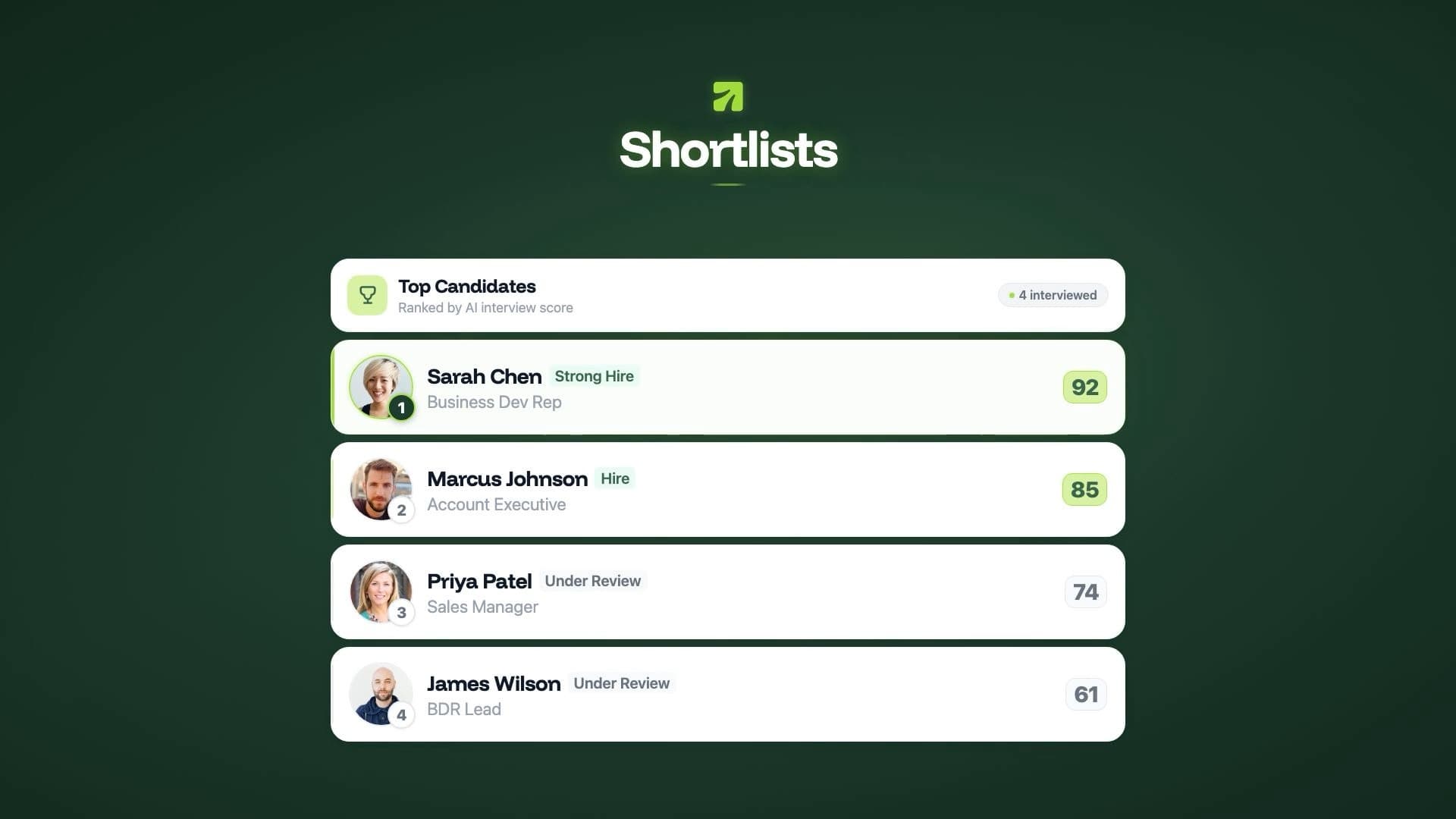
The 2030 recruiter's starting point — an AI-ranked shortlist with evidence. Human judgment begins here, not at the top of the funnel.
What to Do This Quarter
Four concrete actions that put you on the right side of the shift without betting the team.
- 1Run AI-first screening on one high-volume role — Pick a role you fill monthly. Stand up virtual recruiter tools and measure output against last quarter. See the best AI interviewing tools for staffing agencies for a neutral comparison.
- 2Rewrite your scorecards — Every open role should have a structured 5-dimension rubric. If your scorecards don't align with an AI interviewer's output, the data you get back is wasted.
- 3Audit where your week goes — Use the table above. If more than 25 hours a week are spent on fully-automatable tasks, you have a throughput problem that AI screening will fix within a quarter.
- 4Move recruiter time upstream — Reinvest the recovered hours into hiring-manager intake, client strategy, and offer closing. That's where recruiters out-earn AI today and will continue to in 2030.

From the founder
“One of our customers ran 248 candidates through AI screening in 6 weeks and recovered 115+ hours of recruiter time. Their team didn't shrink — the work just shifted upstream. That's the honest answer.”
Frequently Asked Questions
Common questions about AI replacing recruiters, which tasks are automatable today, and what changes by 2030
No. AI will not replace recruiters, but it will replace roughly 40% of what recruiters do today — resume screening, first-round phone screens, scheduling, and structured evaluation. The work shifts upstream toward hiring-manager partnership, offer closing, and client relationships.
Not as a job category. By 2030, expect the recruiter role to look different: pre-qualification handled by AI, human time concentrated on hiring-manager intake, offer negotiation, and client strategy. High-volume teams that don’t adopt AI will lose on throughput, not headcount.
Based on the week-in-the-life breakdown in this piece, about 40% of a high-volume recruiter’s hours are fully automatable today and another ~25% are partially automatable. The remaining ~35% — hiring-manager calibration, client conversations, offer closing — stays human.
Hiring-manager intake, client relationship management, offer negotiation, and judgment calls on borderline candidates. These tasks combine context, trust, and accountability — none of which LLMs handle reliably in a single shot. 93% of recruiting leaders say human involvement remains essential.
It’s replacing tasks, not roles. RVS iGlobal screened 248 candidates across 9 roles in 6 weeks with AI in recruiting — 4x faster than manual screening, saving 115+ hours. The team didn’t shrink; the work shifted from screening to client strategy and candidate closing.
Hiring-manager calibration, structured scorecard design, candidate-market judgment, and negotiating at offer stage. The recruiters who win will be the ones who treat AI as a screening layer and focus human hours on decisions that require trust and context.
Get Ahead of the Shift on One High-Volume Role
The question isn't whether AI will change recruiting — it already has. The question is whether your team captures the 16 hours a week AI can take off the schedule, or whether a competitor captures them first. Start with one role this quarter and measure the throughput lift yourself.
Continue reading
AI Candidate Screening: The Complete Guide
The pillar guide to AI screening for recruiters, agencies, and outsourcers
Strategic Interview Questions to Ask Candidates
40+ structured interview questions and a scoring rubric for 2026
8 Best AI Interviewing Tools for Staffing Agencies
Compare 8 AI interview platforms on features, pricing, and agency fit