

What Is a One-Way Video Interview?
A one-way video interview is an async screening step where candidates record their answers to a pre-set list of questions on their own schedule. The recruiter is not on the call. Candidates receive a link, record each answer into their webcam (usually with 1–3 retakes), and submit before a deadline — typically 48–72 hours. The recruiter reviews the recordings later, often at 1.5× playback, and scores them against a rubric.
The format is also called an async video interview, an on-demand video interview, or a pre-recorded interview. A well-designed one-way video screen is 3–8 questions long, 30–90 seconds each, for a total candidate time of 8–15 minutes. Any longer than that and completion rates collapse — the aggregate industry ceiling across SparkHire, VidCruiter, and Capterra case studies sits at 60–70% invite-to-scorecard completion.
It's a screening step, not a replacement for live interviews. Done well, it replaces the first phone screen — not the hiring-manager conversation, not the panel, and not the reference call. Teams pair it with AI resume screening upstream and live interviews downstream.
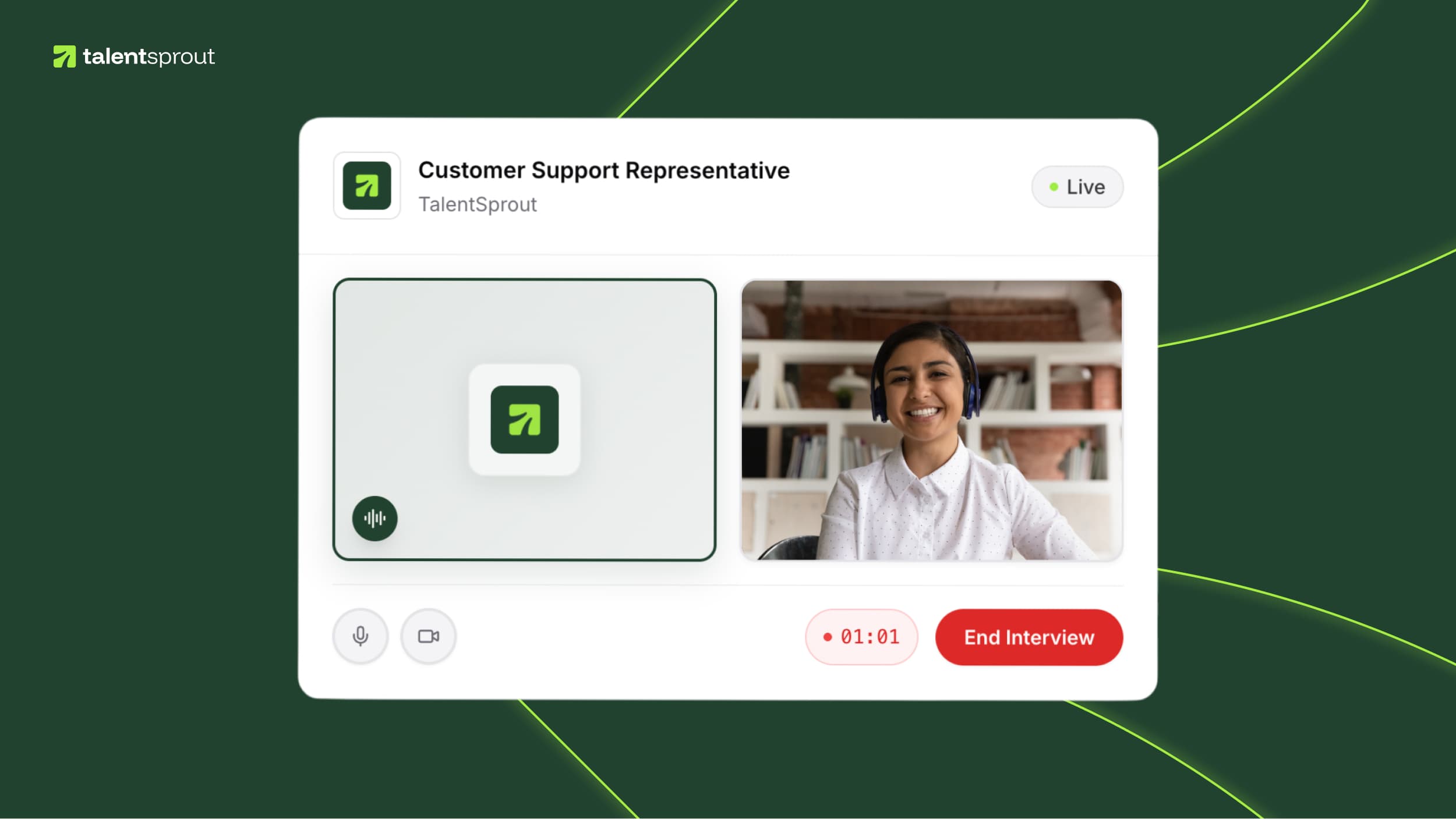
How One-Way Video Interviews Actually Work
From the recruiter's side, a one-way video interview workflow is four steps. The candidate experience is simpler: receive a link, record, submit.
Build the question set
Pick 3-8 questions total. Keep each one to 30-90 seconds. Mix a warm-up, two behavioral prompts, a skill probe, and a role-fit question. Record a short intro video for each prompt so candidates see a human, not just text.
Send the invite
Candidate gets a link by email or SMS — no calendar, no scheduling. Give them 48-72 hours to complete, and include expected length and retake rules in the invite. This is the single biggest lever on completion rate.
Candidate records on their schedule
They answer each question on webcam, usually with 1-3 retakes per prompt. Average total time: 8-15 minutes, most of it done on a phone, most of it at night or on weekends.
Recruiter reviews and scores
The recruiter reviews recordings at 1.5x playback against a shared rubric, shortlists the top ~20%, and passes those to live interviews. Good platforms timestamp, transcript, and auto-surface strong answers.
The candidate side is the part recruiters often forget. Candidates do this after hours, one-handed on a phone, in a room they would rather not film. The best completion rates come from short invites, clear deadlines, and a human-recorded intro video on every prompt.
One-Way Video vs Two-Way Video vs Conversational AI
Three async-and-live formats, three very different funnel shapes. The honest comparison is invite-to-scorecard completion — which candidates actually finish — not “once booked” conversion, which hides scheduling drop-off.
| Dimension | One-way video | Two-way video (live) | Conversational AI voice |
|---|---|---|---|
| Sync vs async | Async — candidate records alone | Sync — live with recruiter | Async — AI runs the conversation |
| Recruiter time per candidate | 10-15 min to watch + score | 30-45 min live + scheduling | 2-4 min to scan scorecard |
| Invite-to-scorecard completion | 60-70% | ~40-55% (incl. scheduling drop-off) | 84% (RVS iGlobal, 248 candidates) |
| Time-to-shortlist | 3-5 days | 1-3 weeks | Same day |
| Best for | Mid-volume, behavioral depth | Senior, culture, closing | High-volume, standardized roles |
| Candidate friction | Medium — recording anxiety | High — scheduling + prep | Low — answer a call |
| Scoring consistency | Reviewer-dependent | Reviewer-dependent | Rubric-enforced by AI |
Completion = candidates who complete a recorded screen ÷ candidates invited. For two-way video, this includes the full scheduling funnel (invite → book → attend → complete), where most drop-off happens before a candidate is ever “booked.” ← Scroll to see all columns →
Short version: one-way video is a huge upgrade over phone tag. Conversational voice AI is a huge upgrade over one-way video — especially at volume. Pick based on how many roles you need to process per week, not based on which vendor's demo you saw last.
Why Hiring Teams Use One-Way Video
One-way video is popular with staffing agencies, IT outsourcers, BPOs, and mid-market in-house teams for a specific reason: it reclaims the most expensive hour in the recruiter's week — the first phone screen.
Reclaim 5–10 recruiter hours per role
Replacing 20–30 first-round phone screens (30–45 minutes each) with a 10–15 minute recording collapses the most repetitive block on the calendar. Recruiters review at 1.5× speed, skip weak answers, and score against a rubric instead of taking notes on the fly.
Screen more candidates without adding headcount
A recruiter can run 8–10 phone screens in a day. A one-way video queue can hold 100 at once. For agencies that need to ramp fast when a client contract lands, that elasticity is the difference between filling the order and losing it to a competitor. For a deeper read on how this plays out across the funnel, see our virtual recruiter overview.
Standardize evaluation across reviewers
Every candidate gets the same questions, same order, same length. Two reviewers can score the same candidate independently and compare — which is impossible with phone screens because nobody remembers the conversation the same way. This alone reduces reviewer bias more than most fairness training.
Cut time-to-shortlist from weeks to days
Invite Monday, recordings in by Wednesday, shortlist by Friday. The scheduling funnel is gone. For clients who measure you on turnaround, this is the single most visible win.
Give hiring managers something to watch, not just read
Hiring managers make better decisions when they see a 90-second clip than when they read recruiter notes. Sending three 2-minute clips instead of five resumes pulls them into the loop earlier and compresses the feedback cycle.
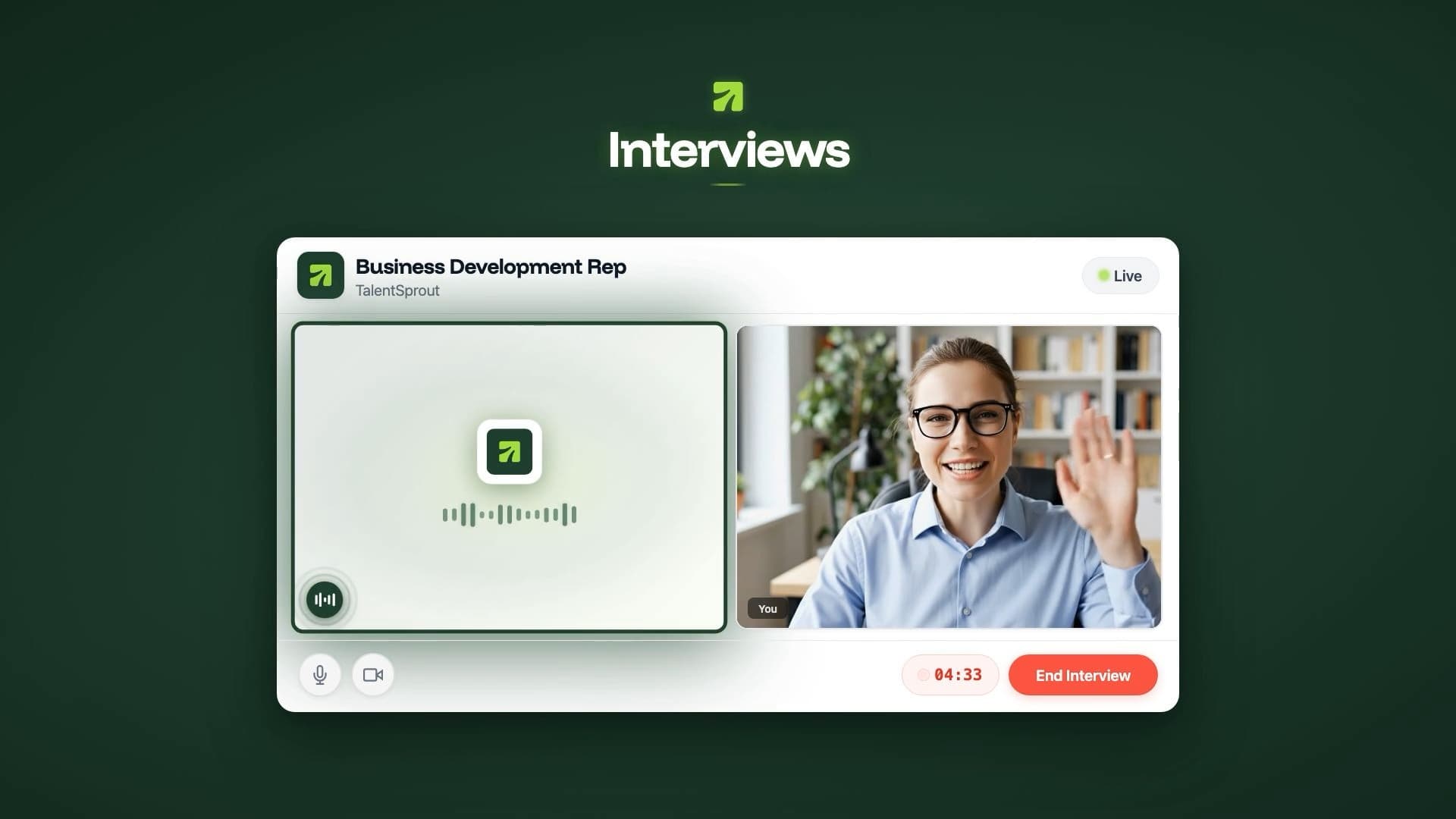
The Candidate Experience, Honestly
One-way video interviews are polarizing. Some candidates prefer them over coordinating a live call. Others find recording themselves deeply uncomfortable. Both reactions are valid, and both show up in every Reddit thread on the format. Here are the themes we hear most often.
CriticalThe format is uncomfortableRecording my own face back at me while a timer ticks down is the single weirdest interview format I've ever done. I get why companies use them, but nobody tells you that part going in.
CriticalThe silence afterward is worseI spent 45 minutes on a one-way video and never heard back. Not a rejection, not feedback, nothing. At least a phone screen feels like I talked to a person.
MixedGeneric questions waste everyone's timeThe questions were generic — ‘tell us about yourself,’ ‘why this role’ — same stuff I already wrote in the cover letter. If you're going to make me record for 15 minutes, ask me something I can't just copy-paste.
PositiveIt beats scheduling a callHonestly? I prefer it. I can do it at 9pm in sweatpants, I don't have to take PTO, and I get three retakes. Way better than scheduling a call at 2pm on a Tuesday.
— Composite of recurring candidate feedback we hear across forums, reviews, and our own candidate debriefs. Paraphrased for clarity; not attributed to any single source.
What separates a good one-way screen from a bad one
Keep it under 15 minutes total.
3-5 questions at 60-90 seconds each, plus setup time. Anything longer is where completion rates fall off a cliff.
Record a human intro on every prompt.
Text-only prompts feel like a form. A 10-second video of an actual recruiter asking the question closes the empathy gap and drives completion 8-12 points higher.
Send a real response, fast.
The biggest candidate complaint is silence. A same-day “we received it” email and a 5-day decision SLA beat every UX polish.
Allow retakes. Say so in the invite.
Candidates who know they get 1-3 retakes are less anxious, record better answers, and rate the experience higher. Unlimited retakes is worse — it pushes perfectionism.
Ask questions a recruiter would actually ask.
Skip “tell us about yourself” — it’s on the resume. Ask about tradeoffs, stuck projects, what they’d change about the last role. The format isn’t the problem; generic questions are.
The candidates who hate one-way video are not wrong. The format is uncomfortable, the silence afterward is worse, and the questions are often recycled. Teams that treat it as a courtesy, not a gate, get better completion, better answers, and fewer Glassdoor complaints.
What Good One-Way Video Interview Questions Look Like
The best one-way video interview questions mirror what a good phone screen would ask: short, specific, hard to bluff in 60 seconds. Below is a six-question set we use as a starting template for a mid-level technical or commercial role. For volume roles — especially customer service — start instead with our dedicated customer service interview questions guide, which uses a 5-dimension rubric tuned for call centres and BPO contact centres.
| # | Type | Example question |
|---|---|---|
| 1 | Warm-up | In 60 seconds, walk us through the last role on your resume — what you owned and what shipped. |
| 2 | Behavioral | Tell us about a project where the scope changed mid-way. What did you push back on, and what did you give up? |
| 3 | Skill probe | Walk through how you would approach [role-specific task]. A whiteboard is fine — show your reasoning. |
| 4 | Role fit | What about this role maps to the work you’ve been doing? What would be new for you? |
| 5 | Judgment | Describe a time you disagreed with a manager or teammate. How did it resolve? |
| 6 | Motivation | Why are you making a move now, and what would you need to see in the first 90 days to know you made the right call? |
← Scroll to see full question set →
Questions to avoid
- Trivia and factual recall. Anything a candidate could Google in five seconds is a waste of their minute.
- “Tell us about yourself.” It's on the resume. Replace it with a warm-up that points at the last role.
- Hypotheticals with no constraints. “What would you do if…” gets rehearsed answers. Ask about a real thing they did.
- More than eight questions. Completion rate falls ~10 points for every 5 extra minutes of runtime.
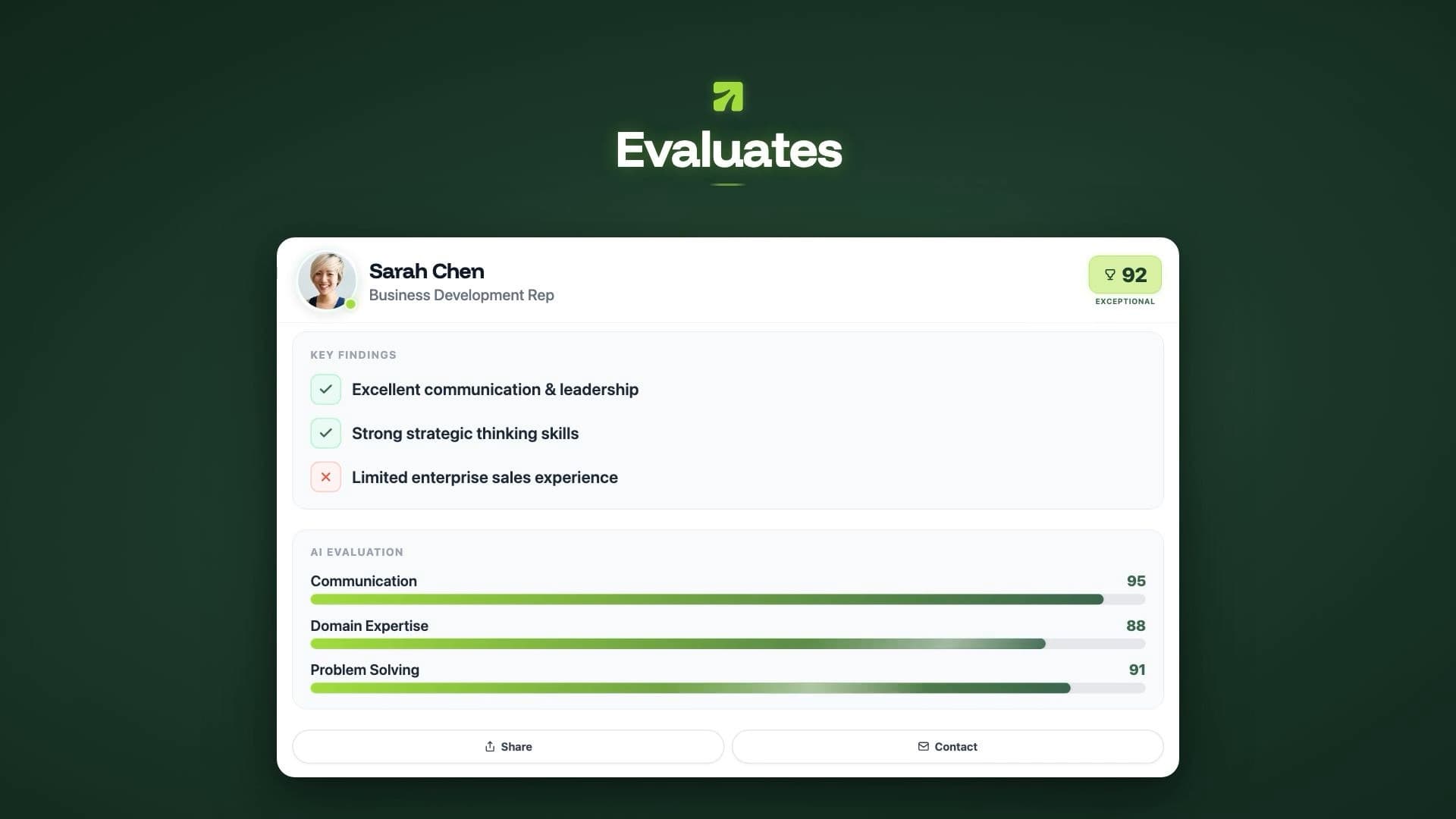
On the reviewer side, every question maps to a rubric row. Here is what the scorecard looks like once the candidate submits:
The One-Way Video Interview Platform Stack (2026)
An honest read of the main one-way video interview platforms, focused on what staffing agencies and high-volume hiring teams actually buy. Pricing verified April 2026. We include our own product here — the row is tinted so you can flag it as first-party.
Transparency note: TalentSprout makes AI candidate screening software. We include competitors and flag our own row so you can weigh the comparison accordingly. Pricing is from each vendor's public page as of April 2026 and may have moved.
| Platform | Best for | Pricing | Notable gap |
|---|---|---|---|
| Hireflix | Solo recruiters, small teams | From $75/mo | No AI scoring, basic integrations |
| Spark Hire Meet | Agencies wanting simple async video | $149 / $299 / $499 per month | Minimal AI, no conversational follow-up |
| Willo | Global hiring, 50+ languages | $279-$409/mo (annual vs monthly) | AI features are add-on, review UX dated |
| VidCruiter | Structured, compliance-heavy workflows | Custom (enterprise) | Long implementation, higher ACV |
| Criteria Corp | Assessments bundled with video | Custom | Assessment-first, video is secondary |
| HireVue | Fortune 500, regulated industries | Custom (enterprise only — no public pricing) | Enterprise-only, slow to set up |
| TalentSprout | High-volume teams, voice-first AI | From $199/mo | Newer in the one-way category — voice AI is the primary product |
← Scroll to see all columns →
For a deeper head-to-head that includes conversational-AI tools alongside one-way video software, see our best AI interviewing tools roundup. If you're specifically shopping against HireVue at enterprise ACV, see our HireVue alternatives comparison.
Live Deployment Data: What Completion Rates Actually Look Like
Most one-way video interview vendors quote completion rates from controlled case studies. The more interesting number is what happens when a team runs the format for six weeks on real requisitions. Here is one of ours.
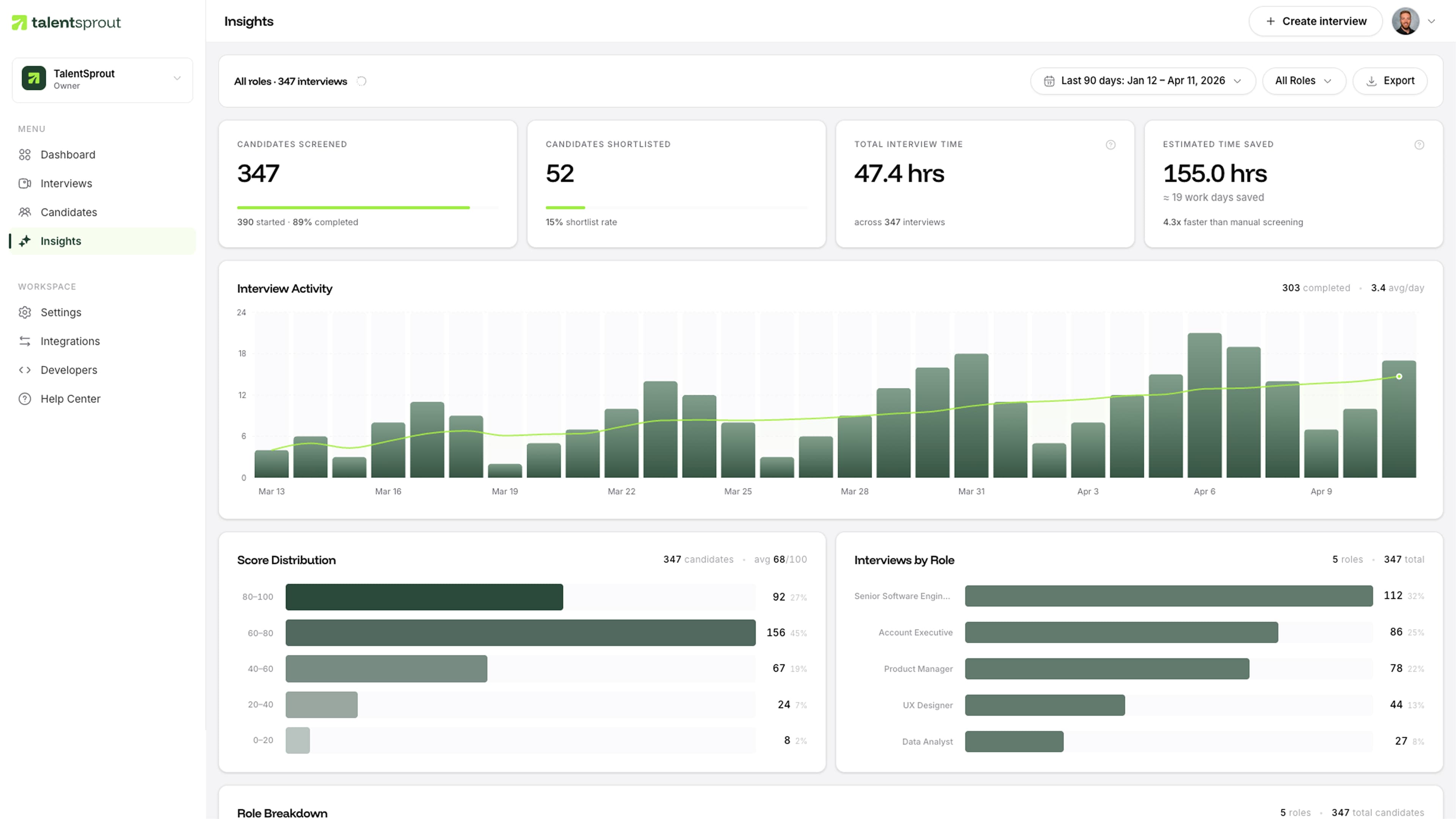
RVS iGlobal, an IT outsourcing firm, ran TalentSprout's voice-first async screening across 9 technical roles over a 6-week period in Q1 2026. They screened 248 candidates, auto-shortlisted 103 (a 42% shortlist rate), and saved more than 115 recruiter hours — interviews averaged 5–10 minutes of AI-led conversation compared to 30–45 minutes of manual phone screens, making the process roughly 4× faster overall.
The 84% completion rate is the number worth dwelling on. It clears the 60–70% ceiling for video-based one-way interviews by 14–24 percentage points, and it held up across 6 weeks of real deployment — not a controlled 2-week pilot. Every candidate who answers a phone call instead of recording themselves on camera is one less candidate lost to the “I'll do this tonight” drop-off.
“TalentSprout has become an essential part of how RVS iGlobal screens talent.”

Tim Jamieson
Director of Global Operations, RVS iGlobal
The full breakdown — role-by-role shortlist rates, fraud-detection flags, and a timeline of how the team expanded from 4 to 9 roles without being prompted — is in the RVS iGlobal case study.
When to Evolve Beyond One-Way Video: Conversational AI as Step 2
One-way video solves three problems cleanly: phone tag, scheduling, and first-pass scoring. It doesn't solve three others — and those are usually the ones that push teams toward voice-first AI as the next step.
Problem 1 — the completion cliff
Even the best-run one-way video screens sit at 60–70% completion. For teams running 10+ requisitions, that's hundreds of candidates lost each quarter to recording anxiety, camera-on friction, and deadline slippage. Voice AI removes the “film yourself” step, and our live deployment hit 84% on the same candidate pool.
Problem 2 — the reviewer bottleneck
Watching 30 recordings at 1.5× still costs a recruiter a full day. The bottleneck just moves downstream. Voice AI produces a rubric-scored scorecard as the interview ends — the recruiter scans, not watches.
Problem 3 — same questions for everyone
One-way video is rigid by design — every candidate gets identical prompts, no follow-up questions, no probing when someone gives a surface-level answer. A conversational AI can ask, “you mentioned a tradeoff — walk me through the one you pushed back on,” which is what separates a screen from a transcript.
Stick with one-way video when
- You are running under 5 requisitions at a time
- Behavioral depth matters more than throughput
- Your team is not ready for AI-scored interviews
Move to conversational AI voice when
- You are screening 20+ candidates per role
- Completion rate on your one-way screens is stuck below 70%
- Recruiters are spending more time reviewing than hiring-manager intake
- You need a rubric-scored scorecard the moment the interview ends
This is not a generational replacement — one-way video is not going anywhere. For a broader read on where these workflows sit inside the recruiter role, see our take on will AI replace recruiters, and for the async-to-live-to-AI handoff pattern, see the virtual recruiter breakdown.
The 30-Day One-Way Video Interview Implementation Plan
Four weeks from first-time setup to a scaled, measurable process. This is the exact rollout pattern we see work across staffing agencies, IT outsourcers, and in-house TA teams hiring 20 to 200 people a year.
Set up
- 1Pick a platform from the stack above — match budget to team size
- 2Write 4-6 core questions plus 2 role-specific skill probes
- 3Record prompt intros so candidates see a human, not just text
- 4Build a 1-5 scoring rubric across 3-4 dimensions
- 5Draft the invite email with deadline and expected length
Pilot on one role
- 1Invite 20-30 candidates on your highest-volume open req
- 2Watch the first 5 end-to-end before you start scoring anyone
- 3Have 2 reviewers score the same 10 to calibrate the rubric
- 4Log completion rate, time-to-shortlist, and candidate sentiment
Scale
- 1Roll to 3 more roles across a mix of seniority levels
- 2Track completion rate weekly and target a 60% floor
- 3If completion is under 60%, rewrite the invite email and shorten the set
Decide
- 1Review pilot metrics against your phone-screen baseline
- 2If it's working, roll one-way video to every open req
- 3If completion is stuck below 70%, pilot conversational voice AI next
The 30-day window isn't a hard constraint — it's a forcing function. Teams that skip Week 2 calibration almost always rewrite their rubric in Month 2 anyway. Better to do it up front on 10 candidates than after 100.
Frequently asked questions
What recruiters and candidates ask about one-way video interviews
A one-way video interview is an async screening step where candidates record answers to pre-set questions on their own schedule. There is no recruiter on the call — it's a recording, not a conversation. Teams use it to screen more candidates without adding recruiter hours.
Typical one-way video interview questions are short behavioral, skill, and motivation prompts — 3 to 8 questions total, 30 to 90 seconds each. Examples: walk us through a project you led, describe a tradeoff you made, why this role. Avoid trivia and anything you would Google in five seconds.
Read every question before recording, plan 60-second answers using a simple structure (situation, action, result), test your camera and mic once, then record in a quiet, well-lit spot. You usually get 1-3 retakes per question. Submit before the deadline — most platforms close the invite after 48-72 hours.
It's called one-way because only the candidate is on camera — the recruiter is not live. The candidate gets a link, records answers to preset prompts, and the recruiter reviews the recordings later on their own schedule. It replaces the first phone screen, not the final interview.
Wear what you would wear to a first in-person interview for that role: business casual for most corporate jobs, a collared shirt or blouse, solid colors that contrast with your background. Skip busy patterns and reflective accessories — they read worse on compressed video than in person.
Total candidate time should be 8-15 minutes: 3-8 questions at 30-90 seconds each, plus a minute of setup. Longer formats push completion rates down fast. If you need more depth, run a shorter one-way screen first and move strong candidates to a live interview — not one 25-minute recording.
They are fairer than unstructured phone screens when every candidate gets the same questions in the same order, scored against a shared rubric. Risks show up in review (not recording) — watching a dozen videos is where bias creeps in. Structured scorecards and reviewer calibration are what make the format fair.
One-way video interview platforms start around $75/mo (Hireflix) and run to custom enterprise pricing (HireVue, VidCruiter). Mid-market tools like Spark Hire Meet sit at $149-499/mo; Willo is $279-409/mo. TalentSprout starts at $199/mo and adds conversational voice AI on top of recorded-video workflows.

From the founder
“The teams that get the most out of one-way video are the ones who treat it as a courtesy, not a gate. Keep it short, close the loop fast, and move the high-signal conversation to voice AI once completion stalls. That's how a 60% funnel becomes an 84% funnel.”
Continue reading
AI Candidate Screening: The Complete Guide
The pillar guide covering every AI screening format, not just one-way video
How RVS iGlobal Saved 115+ Hours with AI Screening
The full 248-candidate, 9-role, 6-week deployment breakdown
Will AI Replace Recruiters? What the Data Shows
Where one-way video, voice AI, and the human recruiter role all sit in 2026