

The 18 Customer Service Interview Questions at a Glance
Five categories, eighteen customer service representative interview questions, a single 45-minute interview. Each category surfaces a different signal — skip one and you either over-index on likability or miss the candidate who looks strong on paper but burns out at 60 days. Each question comes paired with sample answers so you can calibrate your scoring against the same bar.
| Category | # Questions | What It Reveals | Interview Stage |
|---|---|---|---|
| Personality & Motivation | 4 | Why the candidate keeps choosing this work | Opening 10 minutes |
| Behavioral | 4 | How they’ve actually handled hard moments | Middle — highest weight |
| Situational | 4 | Judgment and composure under pressure | Middle — filters junior candidates |
| Skills & Role Fit | 4 | Tool fluency, channel flex, pace tolerance | Before closing — ramp predictor |
| Closers | 2 | Motivation depth and curiosity | Final 5 minutes |
← Scroll to see full table →
Why Customer Service Interviews Fail More Than Other Roles
Customer service interview questions are the structured questions a hiring manager asks to predict how a candidate will handle a real customer on a real bad day. They're different from interviews for most other roles because the job itself is different — high volume, high repetition, high emotional load, and almost no room for a quiet morning.
In staffing agencies and BPO/contact-centre environments, the hiring bar is usually set by the candidate's CV and a 30-minute chat. That's enough to filter for presentability. It is not enough to filter for the three things that actually predict a 90-day hire: tolerance for pace, willingness to own mistakes, and the instinct to acknowledge before defending.
Hiring managers lose candidates in the first 60 days for one of three reasons: the rep can't sustain the queue, the rep takes every complaint personally, or the rep freezes when the customer goes off-script. None of these reasons show up in a resume. All of them show up in the 18 questions below — if you ask them the same way every time and score them against the same rubric.
That consistency problem is also why teams hiring at volume increasingly pair a structured question set with AI candidate screening. Humans drift. A rubric applied by a human at 4pm on a Thursday is not the same rubric applied at 10am on a Monday, and candidates interviewed late in the pipeline pay the price.
The best customer service rep I've ever hired failed her first interview with me. I was tired, she was nervous, and I scored her a 2 on empathy when she was easily a 5. The rubric caught me. It didn't catch her.
Personality & Motivation Questions (4)
Open the interview here. Personality questions lower the candidate's temperature, surface authentic motivation, and give you a baseline for the pressure questions that follow. Every question below comes with a sample answer snippet so you can calibrate — customer service interview questions and answers are only useful when scored against the same bar.
What made you want to work in customer service?
Opens the interview without pressure and surfaces motivation in 30 seconds. Candidates who have a specific reason — a job they enjoyed, a person they admired, a time they liked solving a stranger’s problem — tend to outlast candidates who default to “I like helping people.” Generic answers aren’t disqualifying on their own, but they’re a signal to probe harder on questions 5 and 17.
A specific moment: a summer job, a retail shift, a time they talked someone off a ledge over chat. The answer is about them, not about the role description.
“I’m good with people.” No story, no specificity, no sense that the candidate has thought about why they keep coming back to this work.
Sample answer snippet
“I worked the returns counter in a big-box store for two summers. I liked the moment someone walked up angry and left actually thanking me. Sounds small but it’s still the part of the job I like best.”
How do you handle stress on busy days?
Pace tolerance is the single hardest trait to assess from a resume and the single best predictor of 90-day retention in call centres and BPO environments. Candidates who name a specific strategy — short walks, deep breaths, a playlist, rotating between queues — have usually lived through a hard Tuesday. Candidates who deflect (“I just push through”) often haven’t yet.
Names a concrete strategy and ties it to a real shift. Bonus if they acknowledge their own early-career mistakes with pace.
“I don’t get stressed.” Either untrue or a lack of self-awareness. Both are signals.
Sample answer snippet
“I do a two-minute reset every hour — stand up, stretch, drink water. I learned the hard way that if I skip it at 10am I’m short with the 3pm customer.”
Tell me about a time you felt proud of helping someone.
A softer version of the behavioral question set. The answer reveals what the candidate thinks “great service” looks like, without them performing to a rubric. It’s also the question most likely to surface authentic warmth — which matters on phone and in person in ways that no rubric captures cleanly.
A specific customer, a specific outcome, and language that suggests the candidate remembers the customer — not the process.
A generic “someone was happy at the end” answer, or an example that’s really about the candidate, not the customer.
Sample answer snippet
“An older woman couldn’t reset her online banking password. I stayed on the line 45 minutes past my shift. She called back the next week to ask for me by name. That’s the one I still think about.”
What motivates you to come in to work every day?
Not every customer service job is a calling. The honest answer here is usually some mix of paying the bills, liking the team, and finding the work satisfying in bursts. Candidates who give that blended answer tend to be more reliable long-term than candidates who over-romanticize the role. The question filters for self-awareness, not passion.
A mix of pragmatic (income, schedule, team) and intrinsic (enjoys the work, likes solving problems). Honesty beats performance.
“I’m passionate about customer service.” No candidate is passionate about every shift. Listen for what they’re actually telling you about themselves.
Sample answer snippet
“Honestly? The paycheck is a real part of it. But I also like the rhythm — you start a shift, you finish it, you go home. And the team at my last job was tight. That mattered more than I expected.”
Behavioral Questions (4)
Behavioral questions carry the most weight in this interview. They ask what the candidate actually did — not what they would do — and reveal the patterns that predict the next 12 months more reliably than any other question type. Pair these with strategic interview questions for senior or cross-functional hires.
Tell me about a difficult customer you’ve dealt with and how you handled it.
The single most revealing behavioral question on this list. Every candidate has a hard-customer story — what they choose to tell you is the interview. Listen for whether the candidate frames it as “this customer was impossible” (blame) or “here’s what I did to de-escalate” (ownership). The framing predicts the next twelve months more reliably than the scenario itself.
De-escalation action first, policy second. The candidate remembers the customer’s name or situation and names a specific thing they did to lower the temperature.
Blames the customer, names no de-escalation technique, or frames it as “some people are just impossible.” Pattern-matches to reps who escalate issues upward instead of resolving them.
Sample answer snippet
“A customer was convinced we’d overcharged him — he hadn’t. I stopped trying to prove it mid-call and just said ‘I hear you, let’s walk through the invoice together.’ Took 15 minutes. He apologised at the end.”
Describe a time you made a mistake with a customer. How did you fix it?
Hiring managers at staffing agencies and BPO contact centres consistently rank “owns mistakes” as the highest-predictive behavioural trait — higher than empathy or product knowledge. The question is a direct ownership test. If a candidate says “I can’t think of one,” either they haven’t made one (unlikely) or they haven’t learned from the ones they’ve made.
Names the mistake specifically, describes the fix without deflecting, and ends with what they changed going forward.
“I can’t really think of one” or a story where the mistake was actually someone else’s. Ownership deficit.
Sample answer snippet
“I promised a refund I didn’t have authority to approve. Had to call the customer back and walk it back. I now check the refund threshold before I commit. The customer respected the call-back more than the original promise.”
Tell me about a time you went above and beyond for a customer.
The sibling to the “difficult customer” question, this one tests whether the candidate can recognise their own effort without over-dramatising it. The best answers are small — someone stayed 10 minutes late, someone followed up a week later, someone sent a hand-written note. Grand gestures often mean the candidate is performing for the interview.
A small, specific, unprompted action that exceeded the customer’s expectation. Bonus if the candidate says it felt natural, not heroic.
A story where “above and beyond” is really just doing the job, or a hero story that sounds rehearsed and company-approved.
Sample answer snippet
“A customer’s order was delayed because of weather. I called UPS, got the updated ETA, then called the customer before she had to call us. Tiny thing. She emailed the manager the next day.”
Describe a time you had to work with a teammate whose style was different from yours.
Contact-centre teams live or die on the floor dynamic. This question tests whether the candidate can flex to different communication styles without labelling colleagues as “difficult” — the same trait that predicts how they’ll handle difficult customers. If they can’t adapt to a teammate, they likely won’t adapt to a caller either.
Describes the difference neutrally, names what they did to bridge it, and ends with a working relationship — not a complaint.
Language like “she was just really hard to work with” or “he wasn’t a team player.” Predicts interpersonal friction at scale.
Sample answer snippet
“My teammate liked to process tickets quickly, I liked to dig into the root cause. We split the queue: she took the first-touch tickets, I took the escalations. Took us two weeks to figure out, and it worked the rest of the year.”
Situational Questions (4)
Situational questions are essential for entry-level hiring where most candidates don't have five behavioral stories yet. They test judgment and composure — and they surface the candidates who freeze when a customer goes off-script.
A customer is yelling at you about a problem that isn’t your fault. What do you do?
This is the question where you hear whether a candidate has done this work before. Experienced reps know the first move is never defence — it’s acknowledgement. Inexperienced candidates go straight to “I’d explain the policy,” which is the fastest path to a supervisor call. Listen for the first five seconds of their answer.
Acknowledges the customer’s emotion first (“I’d let them finish” or “I’d tell them I understand why they’re upset”), then moves to the problem.
Goes straight to explaining policy, defending the company, or — worst — “I’d tell them to calm down.” Any of those is a predictor of supervisor escalations inside 30 days.
Sample answer snippet
“First thing I’d do is let them finish without interrupting. Then I’d say something like ‘That’s frustrating, let me see what I can do.’ Then I’d actually work the problem. The order matters.”
A customer asks for something against company policy — how do you respond?
Tests judgment under pressure and whether the candidate understands the difference between “I can’t” and “I won’t.” The best answers hold the line on policy while acknowledging the customer’s want — and know when to escalate to a manager rather than bend the rule themselves.
Declines warmly, offers the closest available alternative, and names when they’d escalate. Doesn’t make the customer feel stupid for asking.
Either gives in to avoid conflict (“I’d probably just do it”) or enforces the rule without any warmth (“I’d tell them it’s policy”). Both patterns cost retention.
Sample answer snippet
“I’d tell them I wish I could, explain what I can do, and if it’s close to the line, I’d get a supervisor on the call. Customers usually feel respected when you loop in a manager instead of just saying no.”
You’re on a call, and you don’t know the answer to the customer’s question. What do you say?
Catches candidates who instinctively bluff — a habit that’s almost impossible to unlearn once it’s in the script. The best reps have a phrase: “I don’t want to give you the wrong answer, let me check,” then actually check. It’s the smallest sentence on this page and one of the most predictive.
Names a specific phrase, then describes the check — a colleague, a knowledge base, a brief hold. Calm and honest.
Anything that sounds like guessing, padding, or “I’d probably just give them the most likely answer.” Bad reps learn to sound confident about the wrong thing.
Sample answer snippet
“I’d say ‘Great question, I want to give you the right answer, not the quick one — mind if I put you on a 60-second hold?’ Nine times out of ten they’re grateful.”
It’s peak hours and your queue is 40 calls deep. How do you stay composed and effective?
Directly probes pace tolerance. Candidates who have done this work have a system — they shorten their greetings, batch similar calls, defer non-urgent follow-ups, check in with a teammate. Candidates who haven’t often describe a feeling (“I’d take a breath”) without a mechanism. The mechanism is what gets you through the shift.
Names 2–3 mechanical adjustments they make under queue pressure — not just emotional ones. Understands that queue management is a skill.
Describes only feelings (“I’d stay calm”) or suggests they’d work faster by rushing the customer. Both burn out a candidate inside 60 days.
Sample answer snippet
“I tighten my greeting script by 15 seconds, save non-urgent follow-ups for after the peak, and flag anything complex for a supervisor instead of owning it mid-rush. Speed without quality is what kills people in peak hours.”
Skills & Role Fit Questions (4)
This block predicts ramp time. A candidate who can name their CRM workflow, flex tone across channels, and acknowledge the mental cost of repetitive work ramps in days — not weeks.
Walk me through how you’d use a CRM or ticketing system on a typical day.
Tool fluency matters for ramp time. A candidate who can describe their Zendesk or Salesforce flow in specifics ramps in days; a candidate who can’t ramps in weeks. Even if your tooling is different from theirs, the shape of the answer tells you whether they think in pipelines — open ticket, gather context, action, document, close — or whether they’ve been coasting on tribal knowledge.
Walks through an actual workflow step-by-step, names the tool by name, and mentions documentation discipline (notes, tags, follow-up flags).
Vague “I’d log the call” answers with no structure. Suggests the last system was run on intuition rather than process.
Sample answer snippet
“In Zendesk, I open the ticket, pull the customer’s last three interactions, action whatever’s needed, tag the ticket with a reason code, and write a one-line note for whoever picks it up next. The note is the part most people skip.”
How do you adjust your tone for phone vs. chat vs. email?
Omnichannel is the default in 2026 and most candidates still answer this question as if it’s 2015. Phone rewards warmth and pace; chat rewards brevity and short sentences; email rewards structure. A rep who flexes between the three deserves a yes. A rep who uses “the same tone everywhere” is usually mediocre on at least two of the three.
Names a specific adjustment per channel and gives an example. Understands that customers hear tone differently across mediums.
“I just stay professional.” Professional means nothing across channels — ask for specifics.
Sample answer snippet
“On phone I slow down and match energy. On chat I keep it short, two sentences max per message, and use the customer’s name. On email I structure it — summary, action, next steps — so they don’t have to re-read.”
How comfortable are you with repetitive work — asking the same five questions 60 times a day?
Directly addresses the part of the job that burns out hires. Candidates who pretend they love repetition are performing; candidates who acknowledge it’s the trade-off for the rest of the role are telling you the truth. Honesty here is a proxy for honesty on the floor.
Acknowledges the repetition honestly, names a mental strategy for staying sharp, and doesn’t oversell their tolerance.
“I love it.” Nobody loves asking ‘what’s your order number’ 60 times a day. Candidates who can’t name the downside often can’t handle it.
Sample answer snippet
“It’s the hardest part of the job for me, but I’ve learned to treat each call as its own thing. The customer doesn’t know it’s my 40th identical call. I try to make sure it doesn’t sound like it.”
What does good customer service look like to you, in one sentence?
A fast-twitch constraint. The constraint (“one sentence”) strips performance and forces the candidate to commit. The best answers are short, specific, and customer-centred. Long, policy-centred answers are often an indicator of a candidate who hides behind the company.
Under 15 words, customer-centred, and passes the “does this actually mean something” test.
Fills 30 seconds with buzzwords (“world-class,” “exceeding expectations”). Either doesn’t have a point of view or is hiding it.
Sample answer snippet
“Good service is when the customer leaves knowing you actually heard them — even if you couldn’t give them what they wanted.”
Closing Questions (2)
The last five minutes of an interview are where tiebreakers are won and lost. These two questions separate candidates who are shopping from candidates who want this role.
Why do you want this role specifically, not just any customer service job?
Motivation filter. Candidates who have researched you — the product, the team, the shift structure — tend to stay longer. Candidates who can’t distinguish this role from the last five they applied to are usually still shopping. Not a disqualifier on its own; a tiebreaker when the pipeline is close.
Names something specific about the company, the role, or the hiring manager’s team that attracted them. Evidence they did 10 minutes of research.
Generic answers that could apply to any job. “I just need a role, any role” is honest but not encouraging at the closer stage.
Sample answer snippet
“I read that you run a 4-day schedule and that you’ve grown the team 2x this year. Both matter to me. I’m looking for somewhere I can stay.”
What questions do you have for me?
The most underrated close. Candidates who have no questions either haven’t prepared or aren’t curious — either way, not the top of your pipeline. The best candidates ask about the team, the first 30 days, or what the hiring manager wishes they’d known when they started. Listen more than you evaluate here.
Two to three thoughtful questions — about the role, the team, the tooling, or the trajectory. Bonus if one question pushes back gently on something you said earlier.
“No, I think I’m good.” Technically fine; practically, a close-the-loop failure after a strong interview.
Sample answer snippet
“Two questions. First, what does week one look like for a new hire here? Second, what’s the thing that the best rep on your team does that the others don’t?”
Scoring Framework: How to Evaluate Customer Service Answers
Score each candidate 1–5 on the five dimensions below. Under 15 out of 25 — don't shortlist. 15–19 — shortlist with a peer interview. 20–25 — advance without hesitation. The weighting per role type is covered in the FAQ.
| Dimension | What a 1 looks like | What a 5 looks like |
|---|---|---|
| Empathy | Jumps straight to the fix. Doesn’t acknowledge the customer’s feeling. | Names the emotion out loud first. “That’s frustrating” before “here’s what I can do.” |
| De-escalation | Matches the customer’s energy or defends the company. | Lowers the temperature with tone and phrasing. Holds the line without hardening it. |
| Ownership | “I can’t think of a mistake I’ve made.” Deflects fault to customer or company. | Names a specific mistake, the fix, and what they changed afterward. |
| Clarity | Long, policy-heavy answers. Customer has to re-read or re-ask. | Short, plain-language answers. Structures them by summary → action → next step. |
| Pace tolerance | Describes only feelings under pressure. No mechanical adjustments. | Names specific tactics for 40-deep queues: tightens greetings, batches tickets, defers non-urgent items. |
← Scroll to see full rubric →
How AI Screening Changes the Customer Service Shortlist
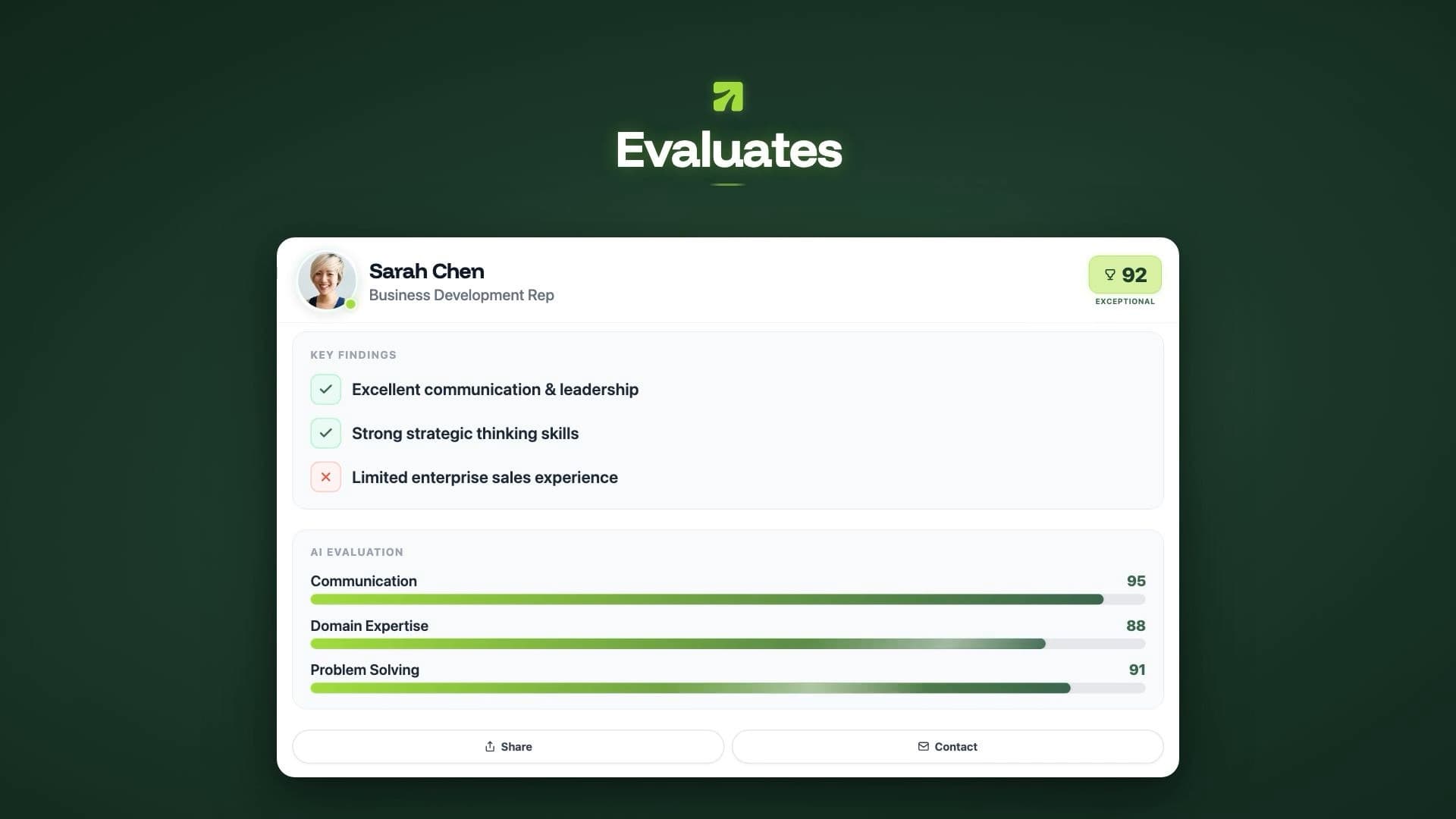
At volume, the 18-question interview hits the same wall every time: consistency. A hiring manager can ask every candidate the same questions on paper; they can't score every candidate against the same rubric after call number 40. AI screening solves that specific problem — not by replacing the interview, but by applying the same rubric to every candidate before a human ever picks up the phone. If you're still evaluating platforms, our comparison of the best AI interviewing tools walks through eight platforms on pricing, features, and agency fit.
A structured AI interview asks the same 6–12 questions from the 18 above, scores each answer against the 5-dimension rubric, and produces a scorecard the hiring manager can read in under two minutes. Candidates above a threshold move to a live peer interview or role-play; candidates below the threshold don't. The rubric stays consistent across shift, reviewer, and day of the week.
In a live deployment at RVS iGlobal, 248 candidates completed AI screening across 9 roles; 42% cleared the shortlist bar, 84% completed the interview end-to-end, and the recruiting team recovered 115+ hours that had previously been spent on repetitive first-round screens. The one-way video interview model is the closest video analog — but voice screening tends to outperform video on completion, especially for customer service candidates who are already comfortable on a phone.
AI doesn't replace the interview. It just makes sure every candidate gets the same interview — so when the hiring manager walks in, they're reviewing a rubric, not a mood.
6 Red Flags That End a Customer Service Interview
Any single red flag is worth probing — candidates have bad moments. Two or more, inside the same interview, is usually enough to move on.
Can’t name a specific customer
Behavioral answers stay in the abstract. No name, no situation, no outcome. Either they haven’t done the work or they haven’t reflected on it.
Blames the customer
Frames hard calls as “they were impossible” rather than “here’s what I did.” Predicts supervisor escalations inside 30 days.
Rigid across channels
Uses the same tone on phone, chat, and email. Usually means they’re mediocre on at least two of the three — customers hear it immediately.
Doesn’t ask questions at the close
“No, I think I’m good.” Either unprepared or incurious. Not disqualifying on its own, but a tiebreaker when the shortlist is close.
Speaks in generalities
“I’m good with people” and “I always give 110%” with no examples. Ask for a story three times and if you still don’t get one, move on.
No reflection on past mistakes
Question 6 is diagnostic. A candidate who can’t name a mistake they’ve learned from hasn’t grown at their last job — and probably won’t at yours.
The six above don't mean the candidate is a bad person. They mean the candidate isn't ready for the pressure of this specific job, on this specific team, in this specific quarter. A hire for a different role, at a different time, is a different conversation.

From the founder
“Customer service is a voice job. The best interview question is the one that captures tone and pace — not the one that captures rehearsed answers to ‘why do you want to work here.’”
Frequently Asked Questions
Common questions about customer service interview questions, scoring frameworks, and AI-screening integration
The best customer service interview questions cover five categories: Personality & Motivation (why they want this work), Behavioral (how they handled real past situations), Situational (what they’d do in hypothetical scenarios), Skills & Role Fit (tools, channels, pace tolerance), and Closers (role-specific motivation and candidate questions). The 18 questions in this guide map to these five categories and work across call centers, BPO/contact centres, retail, and technical support roles.
Five qualities matter most: empathy (hearing the customer before solving), de-escalation (lowering the temperature of an upset caller), ownership (taking responsibility instead of deflecting), clarity (explaining policy in plain language), and pace tolerance (staying composed when the queue is 40 deep). The scoring rubric in this guide scores each candidate 1–5 on all five, then sums to a shortlist threshold.
Follow a five-step pattern every time. 1. Identify the question category — Work out whether the question is personality, behavioral, situational, or skills-based. The category tells you what framework to use and what the interviewer is actually listening for. 2. Recall a specific customer interaction — Anchor your answer to one real customer you helped — not a hypothetical. Concrete beats abstract every time, especially for behavioral questions. 3. Use the STAR format — Structure the answer as Situation, Task, Action, Result with concrete outcomes. Keep each segment under 20 seconds so the full answer lands inside 90 seconds. 4. Name the tools and channels — Cite the CRM, ticketing system, or channels (phone, chat, email) you used. Specificity beats generality when a hiring manager is scoring you against other candidates. 5. Close with what you would do differently — Show reflection. Hiring managers rate self-aware candidates higher — a 20-second “here’s what I’d change” at the end signals a growth mindset. The whole answer should land inside 90 seconds. Interviewers stop listening closely after that.
Behavioral questions ask about something the candidate actually did in the past (“tell me about a time you…”). Situational questions ask what they would do in a hypothetical scenario (“a customer yells at you about…”). Behavioral questions surface real patterns; situational questions test judgment and composure. Use both — behavioral for senior reps with track records, situational more heavily for entry-level and volume hiring where most candidates are early in their careers.
For call centres and BPO/contact centres, weight pace tolerance and de-escalation highest — the pressure of queue volume is the role. For retail and in-person roles, weight empathy and clarity — you’re hiring for face-to-face rapport. For technical support, weight ownership and clarity — customers want the problem explained, not just fixed. The 18 questions are the same across settings; the scoring weights change.
Most high-volume teams over-shortlist. If you’re interviewing 40 candidates for 10 seats, a healthy shortlist is 14–18 — roughly 35–45%. Much higher and you’re underselecting; much lower and you risk missing capacity. AI screening compresses this further: in one live deployment across 248 candidates and 9 roles, 42% shortlisted against 115+ recruiter hours saved, because the rubric was applied consistently on every candidate.
AI screening handles the 60-question consistency problem that human interviewers can’t — asking every candidate the same questions, scoring to the same rubric, in the same 15 minutes. Recruiters then spend their time on the shortlisted 40% doing what humans do well: live role-plays, culture fit, peer interviews. The net effect: same or better hire quality at one-fifth the screening time, with a rubric-consistent top of funnel.
Start Screening Customer Service Candidates Faster
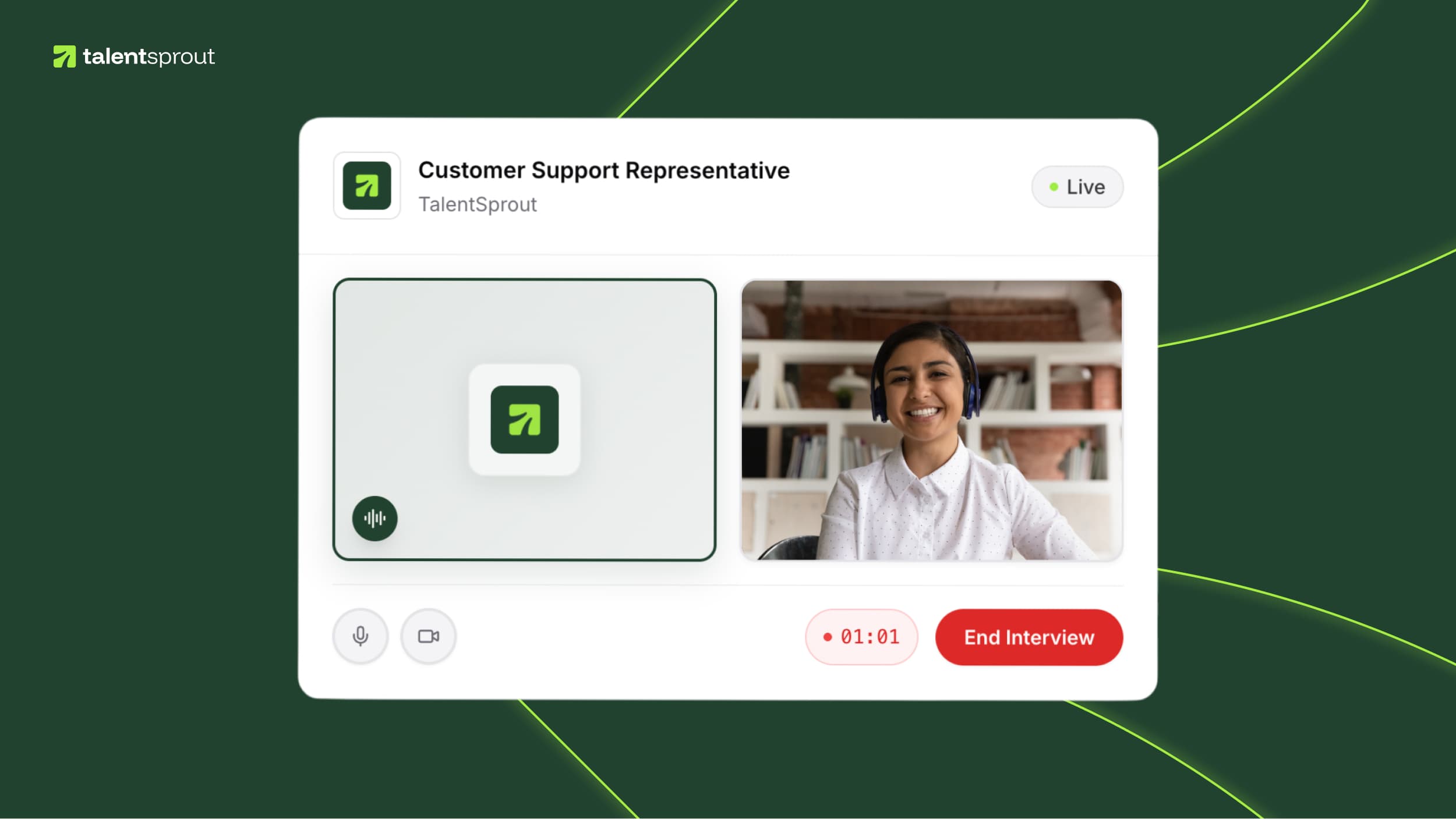
The 18 questions above work best when every candidate gets them — and when every answer is scored against the same 5-dimension rubric. That's where TalentSprout's voice-first AI screening fits: it runs the rubric consistently across every candidate, every shift, every reviewer, and hands your hiring managers a shortlist that's already been graded.
Continue Reading
Strategic Interview Questions to Ask Candidates
The pillar guide for interview evaluation across roles and seniority
10 Essential Reference Check Questions
The final verification layer after the interview — 10 questions with a scoring framework
AI Candidate Screening: The Complete Guide
How AI screening reshapes the top of the recruiting funnel for agencies and BPOs