
How TalentSprout scores candidates. Clear, fair, and configurable.
Every candidate gets a single 0–100 overall score, built from the interview and the resume — with the dimensions that matter to you and weights you control.
The headline number
How the overall score is built
Two things drive the headline number: how the candidate did in the interview, and how their resume aligns to the role. Combined into one score.
Interview evaluation
Strong
The AI's score for how the candidate performed in the conversation.
Resume evaluation
Good
The AI's score for how the candidate's resume aligns with the role.
Overall score
Good — recommend next step
A single 0–100 number on every scorecard.
Weights between interview and resume are set in your Settings — most teams leave the default in place, but you can shift the balance whenever you want. See it in your dashboard →
What goes on the scorecard
What gets evaluated
Click any dimension to expand and see the sub-scores and what the AI looks for.
Sub-scores on the scorecard
Sub-scores on the scorecard
- Communication
- Clarity, articulation, and effectiveness in conveying ideas.
- Domain expertise
- Knowledge and experience relevant to the role.
- Problem solving
- Ability to analyze situations and propose practical solutions.
- Cultural fit
- Alignment with your company values and ways of working.
- Professionalism
- Demeanor, preparation, and overall conduct in the interview.
Sub-scores on the scorecard
Sub-scores on the scorecard
- Experience relevance
- How closely past roles map to what this role requires.
- Skills match
- Coverage of required and nice-to-have skills for the role.
- Education & certifications
- Relevant degrees, courses, and professional credentials.
- Career progression
- Growth trajectory and increasing responsibility over time.
Sub-scores on the scorecard
Sub-scores on the scorecard
- Comprehension
- Understanding of questions, follow-ups, and nuance.
- Fluency & pace
- Natural flow of speech and ability to express thoughts smoothly.
- Grammar & structure
- Correct sentence structure and grammatical accuracy.
- Vocabulary
- Range and appropriateness of word choice for the role.
Sub-scores on the scorecard
Sub-scores on the scorecard
- Define a name
- Give the criterion a clear name your reviewers will recognize.
- Describe what to look for
- Explain to the AI what 'good' looks like, or generate criteria with AI.
- Scored 0–100, individually
- Each custom score appears alongside the standard metrics on the scorecard.
See it in your dashboard
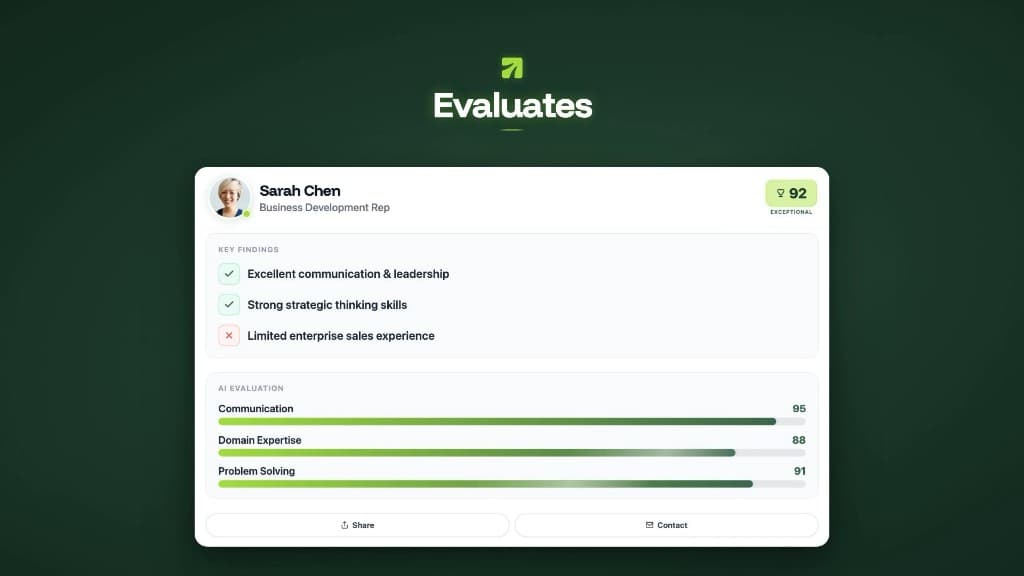
Open any candidate to see the overall score, every dimension's breakdown, and a transparent view of how the number was built.
- Overall score with qualitative label (Exceptional, Good, Average...)
- Expandable rows for every dimension and sub-score
- Transparent 'how this score is calculated' breakdown
- Read the AI's notes for each dimension in seconds
From interview to scorecard
Four steps. No spreadsheets, no manual scoring, no ambiguity.
Configure your role
Pick the dimensions that matter, add custom criteria, and set your scoring balance — all in your dashboard.
Candidate interviews
Candidates complete the AI voice interview. Resume gets reviewed when upload is enabled.
AI evaluates consistently
The same rubric applies to every candidate, every time — interview and resume scored together.
Review the scorecard
Open the candidate, see the overall score, and expand any dimension to read the detail behind it.
“Recruiters shouldn't have to guess how a candidate score was produced. We built evaluation to be configurable, consistent, and explainable — so you stay in control of what 'qualified' means for your roles.”

Evaluation FAQs
Straight answers on scoring, dimensions, and what appears on the scorecard.
The overall score is a single number from 0 to 100 on each candidate's scorecard. It is the headline metric your team uses to compare and triage candidates. It blends the interview and resume evaluations using weights you set for your organization.
TalentSprout combines the AI's interview evaluation with the resume's overall score using your organization's scoring balance. Most teams keep our default — which leans on the interview — but you can adjust the balance in Settings. If a resume isn't uploaded or resume evaluation is off, the overall score is based on the interview alone.
Yes. In Settings, an organization-wide control lets you shift the balance between interview and resume — anywhere from interview-only to a heavier resume weighting. Changes apply to future evaluations only; existing candidates keep the weights stored at the time they were scored.
No. Custom scores are role-specific criteria you define — such as sales acumen or reliability. They appear on the scorecard with their own scores and notes, but they are designed for reviewer detail and do not change the headline overall score.
Every interview evaluates Communication, Domain expertise, Problem solving, Cultural fit, and Professionalism — each on a 0–100 scale. The AI also produces one holistic interview score; the five sub-scores provide detail your reviewers can scan or expand.
When enabled for a role, the AI assesses how the candidate speaks across comprehension, fluency, grammar, and vocabulary. These appear as a separate section on the scorecard for reviewer detail.
Partial interviews are scored fairly: if not all questions were answered, the interview score may be reduced before it combines with the resume — so a partial interview isn't treated as if it were complete. Candidates who don't substantively engage may not receive an overall score.
No. Each evaluation stores the weights and configuration that were active when it was generated. Updating your scoring balance only affects candidates evaluated after you save the change.
Yes. The same rubric, questions, and configured criteria apply to every candidate for a given role. The AI evaluates each conversation and resume against those standards — so scores are consistent and comparable across your pipeline.
Yes. Every candidate scorecard includes a 'how this score is calculated' breakdown showing what fed the overall number, with clear interview and resume contributions. You can drill into any dimension to read the AI's notes behind the score.
Ready to hire smarter?
Start using AI to screen candidates faster and more effectively.