

What Is AI Resume Screening?
AI resume screening is the process of using artificial intelligence — including natural language processing and machine learning — to automatically evaluate candidate resumes against job requirements. Unlike traditional ATS keyword matching, AI screening understands context, synonyms, and relevance to identify qualified candidates.
Traditional applicant tracking systems rely on exact keyword matching: if a resume doesn't contain the precise phrase in the job description, it's filtered out — even if the candidate has directly relevant experience described differently. AI resume screening represents the next evolution: NLP-powered parsing that understands “revenue operations” is relevant to a “sales operations” role, that “managed a team of 12” signals leadership experience, and that a career progression from analyst to director indicates growth trajectory.
For recruiters and staffing agencies handling dozens of open roles simultaneously, this shift from keyword matching to contextual understanding means fewer qualified candidates slip through the cracks — and fewer unqualified resumes clutter the shortlist.
| Feature | Traditional ATS | AI Resume Screening |
|---|---|---|
| Matching Method | Exact keyword matching | Contextual NLP understanding |
| Format Handling | Breaks on non-standard layouts | Parses any PDF/DOCX structure |
| Synonym Recognition | — | |
| Context Understanding | — | |
| Bias Risk | High — penalizes non-standard phrasing | Lower — structured criteria, consistent rubric |
| Speed (100 resumes) | Instant filter | Minutes with scoring |
| Accuracy | High false-negative rate | Contextual relevance scoring |
How It Works
The four-step process from resume upload to ranked shortlist.
Resume Parsing & Data Extraction
The AI ingests resumes in PDF or DOCX format (up to 5MB) and extracts structured data: work history, skills, education, certifications, and contact information. Unlike basic ATS parsers, NLP-based extraction handles non-standard layouts, tables, and multi-column formats without breaking.
Job Requirement Matching
Extracted data is compared against the role's requirements using semantic matching — not keyword matching. The AI understands that 'project management' experience is relevant to a 'program manager' role, and that 5 years of progressively senior roles signals leadership potential even if 'leadership' isn't explicitly mentioned.
Scoring & Ranking
Each resume receives a 0–100 score with color-coded badges: green (80+) for strong matches, blue (60+) for qualified, amber (40+) for borderline, and red for below threshold. Scoring criteria are customizable — weight technical skills heavily for engineering roles, or prioritize industry experience for client-facing positions.
Filtering & Shortlisting
Candidates above the configurable pass rate threshold (default 50%) are automatically shortlisted. Recruiters receive a ranked list with scores, match breakdowns, and links to the original resume. The best candidates surface to the top — no manual sorting required.
What makes AI resume screening powerful is the combination of speed and nuance. A keyword filter is fast but crude — it rejects good candidates for using different terminology. A human reviewer is nuanced but slow — reading 100 resumes takes days. AI for resume screening combines both: it processes hundreds of resumes in minutes while applying the kind of contextual understanding that previously required a human reader.
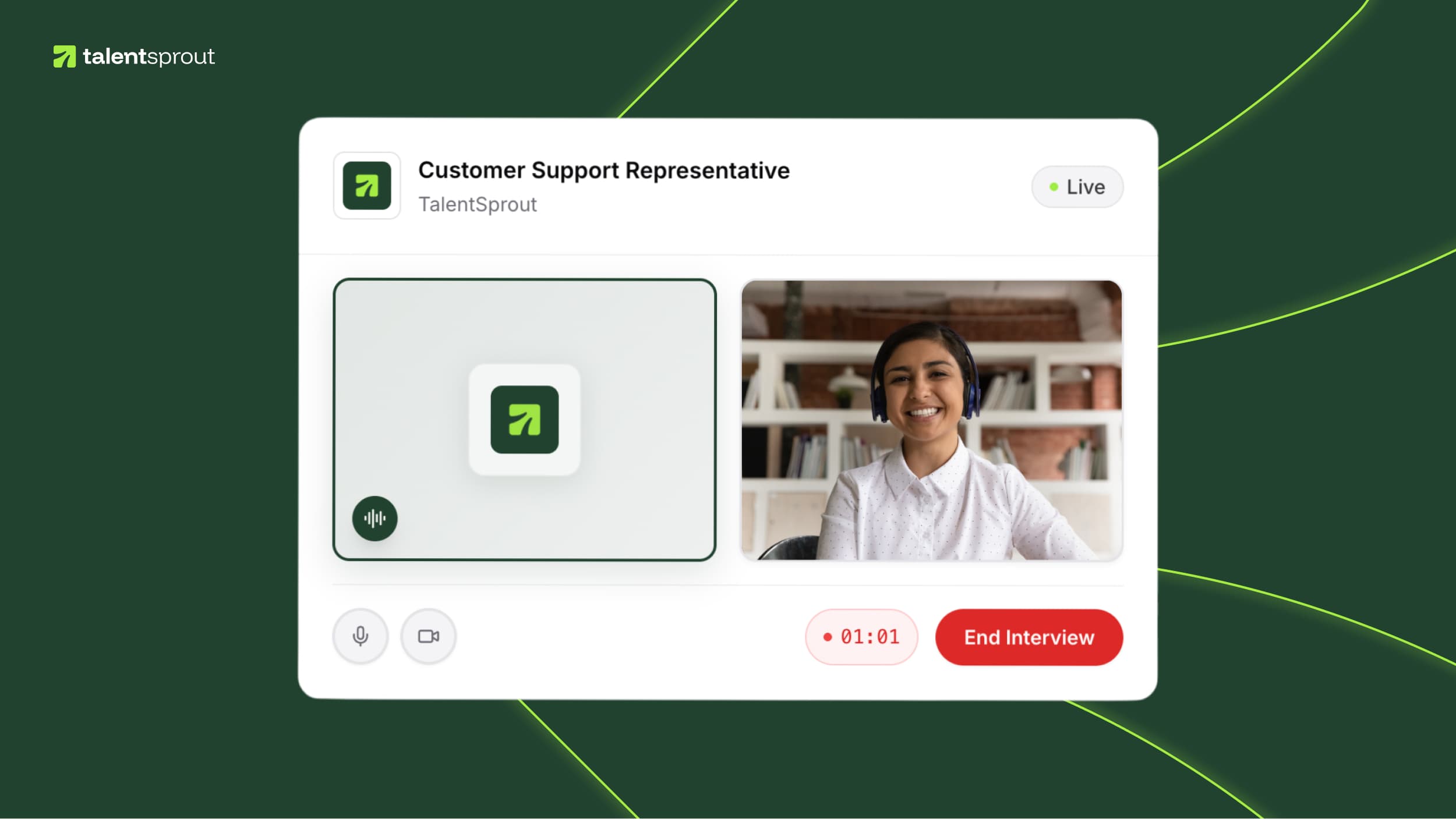
After resume screening, candidates who pass enter the AI interview stage for deeper evaluation.
Why Recruiters Use AI Resume Screening
Four measurable benefits driving adoption across staffing agencies and talent acquisition teams.
Save 15–20 Hours Per Role
Industry research shows recruiters spend an average of 23 hours screening resumes for a single hire. AI resume screening compresses that to minutes. When RVS iGlobal deployed AI screening across 7 active roles, the platform handled approximately 15 hours of screening time in 4 weeks — time their recruiters redirected to client relationship building and closing placements.
Improve Shortlist Quality
Manual screening is inconsistent — different reviewers apply different standards, and fatigue degrades quality throughout the day. AI applies the same scoring rubric to every resume. In the iGlobal pilot, shortlist quality improved from 16% to 43% as the team refined scoring criteria over 4 weeks. The shortlist got better because the criteria were consistent and measurable.
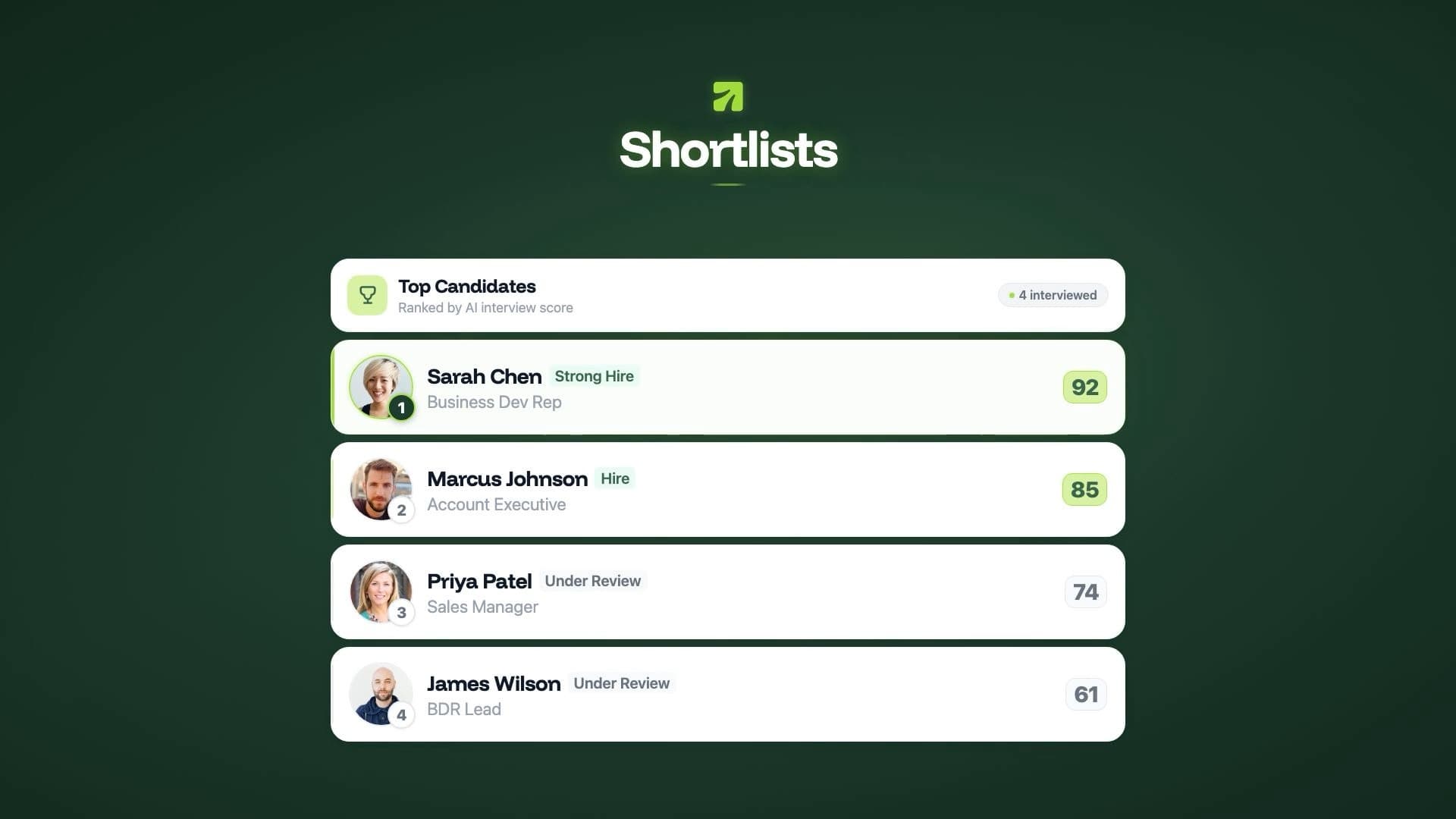
Ranked shortlist with color-coded scores — green (80+), blue (60+), amber (40+) — so recruiters see the best candidates first.
Reduce Bias in Initial Screening
Unconscious bias is well-documented in resume screening: studies show identical resumes receive different callback rates based on name, university, or address. AI resume screening evaluates qualifications against structured criteria — skills, experience, and competencies — rather than proxies. This doesn't eliminate all bias (training data matters), but it removes the inconsistency inherent in human review.
Screen Candidates 24/7
Candidates apply at all hours — evenings, weekends, across time zones. AI screening processes resumes as they arrive, so your shortlist is building overnight while your team sleeps. For staffing agencies handling multiple client orders with tight SLAs, this responsiveness is the difference between submitting candidates first or losing the placement.
AI Resume Screening as a Pre-Screening Step
Resume screening is most powerful when it's not the final filter — it's the first gate in a multi-stage pipeline.
The pre-screening pipeline combines resume analysis with optional questionnaires and AI-powered interviews to create a multi-layered filter. Resume screening handles the first pass: does this candidate's background match the role requirements? Candidates who pass the resume screen can then be routed to a text-based questionnaire for deal-breaker questions (availability, certifications, salary expectations) before entering the AI interview stage.
This layered approach means recruiters only review candidates who've passed multiple quality gates. It's especially powerful for high-volume roles where 200+ applications per posting is common. Once candidates pass pre-screening, they enter the AI virtual recruiter interview — a dynamic, conversational screening that evaluates communication skills, domain knowledge, and role fit.
The interview stage uses strategic interview questions to evaluate candidates against structured scoring rubrics, producing scorecards that rank candidates objectively. The recruiter opens a shortlist the next morning — not a pile of resumes to read.
What to Look For in an AI Resume Screening Tool
Not all AI screening tools are built the same. Here's what separates tools recruiters love from tools that gather dust.
Must-Have Features
- Semantic matching (not just keyword filtering)
- Configurable scoring criteria per role
- Support for PDF, DOCX, and multi-format resumes
- ATS integration (Greenhouse, Lever, Bullhorn, Zoho)
- Customizable pass/fail thresholds
- Structured output: scores, rankings, and evidence summaries
Nice-to-Have Features
- Multi-stage pipeline (resume → questionnaire → interview)
- White-label branding for agency use
- Multilingual support (50+ languages)
- API and webhook access for custom workflows
- Bias detection and compliance reporting
Red Flags
- —No explanation of how scoring works (black box)
- —Requires multi-week implementation with professional services
- —No free trial or demo — enterprise sales process only
- —Uses facial analysis or biometric data in screening
- —Can't integrate with your existing ATS
For a detailed comparison of AI interview platforms including resume screening capabilities, see our HireVue alternatives guide.
How TalentSprout Does It
Full disclosure: TalentSprout is our product. This section describes how our platform implements the concepts above.
TalentSprout offers two pre-screening methods that work together: AI resume screening and text-based questionnaires. When a candidate applies, their resume is automatically parsed and scored against role-specific criteria you define. The pass rate threshold slider (default 50%) controls how selective the filter is — set it higher for specialized roles, lower for high-volume hiring.
Each resume receives a 0–100 score with color-coded badges: green (80+), blue (60+), amber (40+), and red (below 40). Custom screening criteria let you weight what matters most for each role — years of experience, specific certifications, industry background, or technical skills. The system accepts PDF and DOCX files up to 5MB.
Candidates who pass resume screening can be automatically routed to a text questionnaire, then to the AI interview. Templates let you reuse screening configurations across similar roles. Results sync to your ATS via webhooks and native integrations with 45+ platforms. The entire experience is available in 50+ languages.
Need scoring as a standalone capability instead of the full pre-screening flow? The same engine is exposed via the Resume Screening API — drop CVs in from your inbox, Drive folder, ATS, or your own product, get a structured score back.
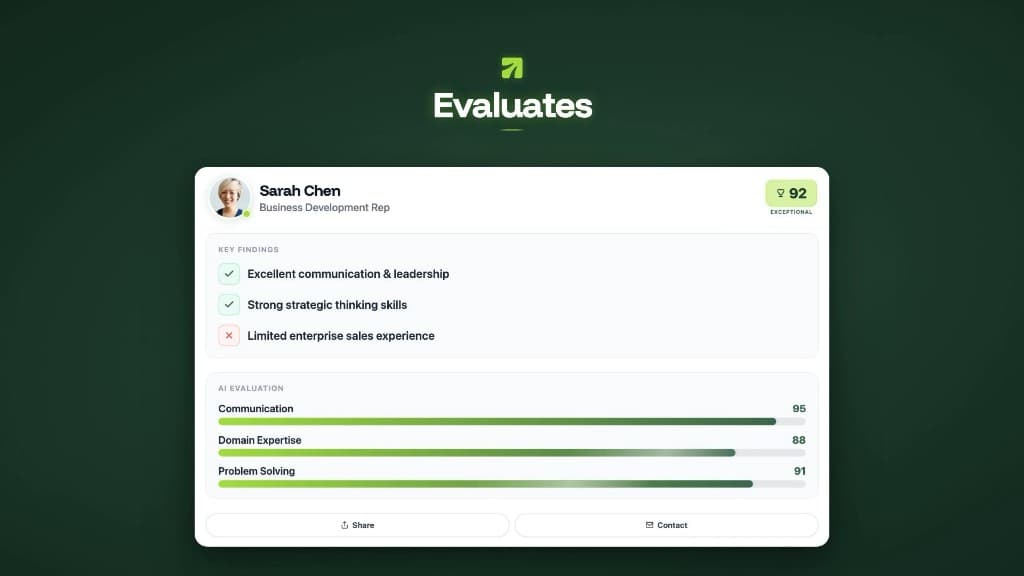
Scorecard view with score breakdown, evidence summaries, and pass/fail indicators for each screening criterion.
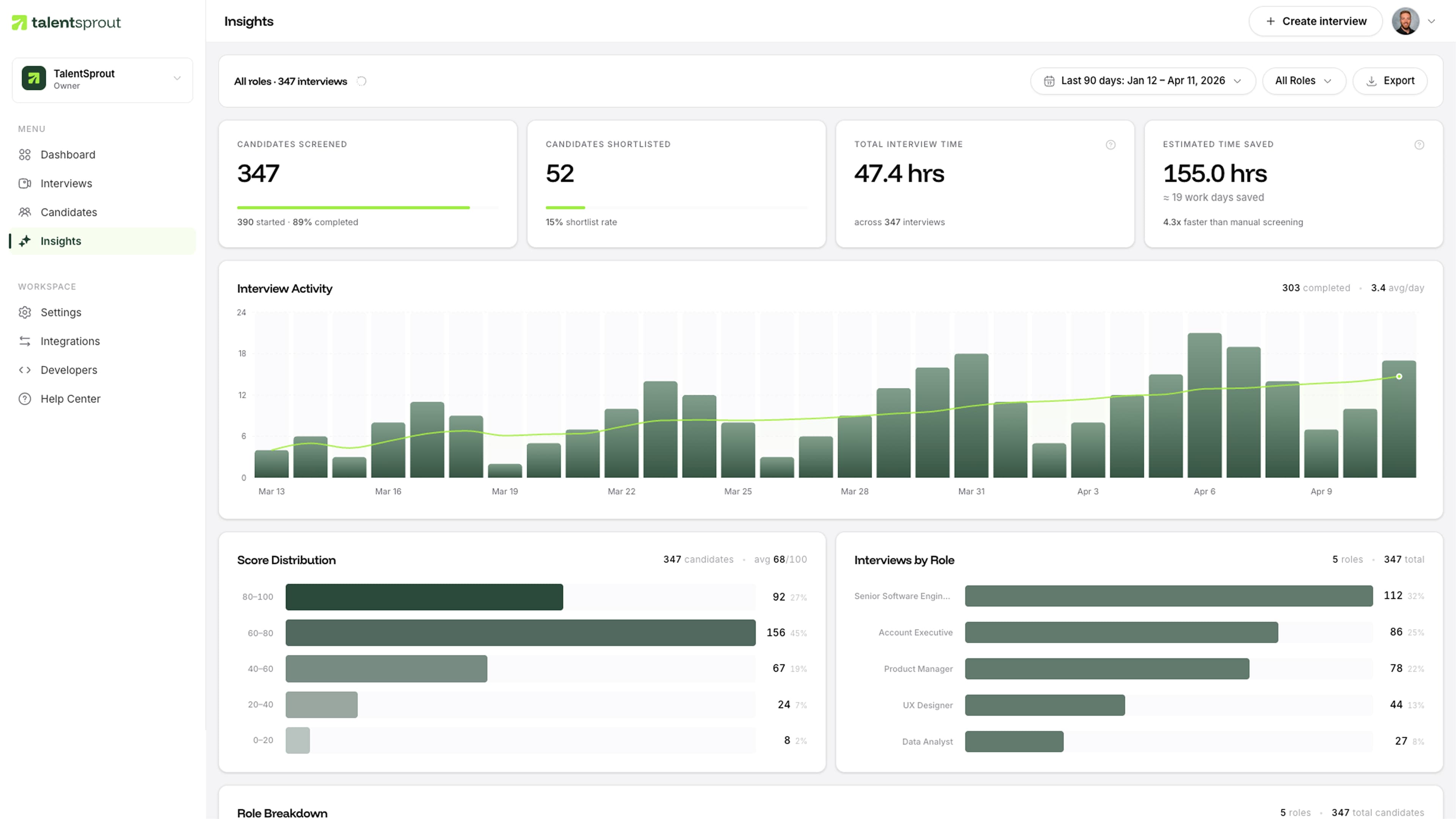
Insights dashboard tracks screening volume, average scores, and pipeline conversion over time.

Common Concerns
Honest answers to the questions recruiters ask before adopting AI screening.
Will AI Miss Good Candidates?
Traditional ATS keyword filters miss good candidates constantly — that's actually the core problem AI screening solves. By using semantic matching instead of exact keywords, AI catches candidates with equivalent experience described differently. That said, no system is perfect. The configurable threshold lets you control the trade-off between selectivity and inclusivity: lower it when you'd rather review more candidates than risk missing someone.
Is AI Resume Screening Biased?
AI systems can inherit bias from training data — this is a real concern, not a hypothetical one. Reputable platforms mitigate this through structured evaluation criteria (evaluating skills and experience, not proxies like school name), regular bias audits, and transparency about how scoring works. Regulatory frameworks are evolving: NYC Local Law 144 requires annual bias audits for automated hiring tools, and the EU AI Act classifies these systems as high-risk. The best approach is structured criteria + human oversight, not blind automation.
Do Candidates Know Their Resume Is Being Screened by AI?
Transparency is both an ethical obligation and increasingly a legal one. Best practice is to disclose that AI is used in the screening process — most candidates expect technology to be involved and appreciate the consistency it provides. Several jurisdictions now require disclosure. Building transparency into your process isn't just compliance — it builds trust with candidates.
Worried AI screening means fewer recruiters? Read the data on whether AI will replace recruiters — the short answer is no, but the week-by-week breakdown of what changes is worth reading before your next planning cycle.
Getting Started
Five steps to go from manual screening to an automated pipeline. Resume screening is one piece of a larger staffing automation workflow.
Pick a High-Volume Role to Start
Choose a role with 20+ applicants where manual screening is already a bottleneck. This gives you enough volume to see meaningful results in the first week.
Define Screening Criteria
List the 3–5 requirements that matter most for this role: years of experience, specific skills, certifications, industry background. These become your AI scoring rubric.
Set the Pass Rate Threshold
Start at the default 50% threshold. You can adjust after seeing the first batch of results — raise it if too many borderline candidates are getting through, lower it if the filter is too aggressive.
Send Your Next Batch of Candidates Through
Upload resumes or connect your ATS so incoming applications are automatically screened. Review the ranked shortlist the next morning.
Refine and Expand
Compare AI shortlist quality to your manual process. Adjust criteria based on what you learn. Once validated, expand to additional roles and add AI interviews as the next stage in your pipeline.

From the founder
“We added resume screening to TalentSprout because we kept hearing the same thing from recruiters: 'I love the AI interviews, but I'm still spending hours reading resumes before I even send the interview link.' Pre-screening should be a pipeline, not a pile. Resume screening is the first gate — the AI interview is the second. Together, they mean recruiters only spend time on candidates who've already proven they fit.”
Frequently Asked Questions
Common questions about AI resume screening, accuracy, compliance, and integration
AI resume screening uses artificial intelligence — including natural language processing and machine learning — to automatically evaluate candidate resumes against job requirements. Unlike traditional ATS keyword matching, AI screening understands context, synonyms, and transferable skills to identify qualified candidates who might be missed by rigid keyword filters.
AI resume screening is significantly more consistent than manual review. Human reviewers spend an average of 6–7 seconds per resume and are influenced by unconscious bias, fatigue, and inconsistent criteria. AI applies the same evaluation rubric to every resume, every time. In practice, teams using AI screening report shortlist quality improvements from 16% to 43% as they refine scoring criteria.
Yes. Leading AI resume screening platforms support 50 or more languages, allowing candidates to submit resumes in their native language. The AI evaluates content regardless of language, and recruiters receive standardized scores and summaries. This is especially valuable for staffing agencies placing candidates in multilingual markets.
Pricing varies by platform and volume. TalentSprout plans start at $199/month and include unlimited AI interviews and resume screening. At scale, the cost per screen is roughly $2–5 compared to $15–25 for manual review. Most teams see ROI within the first week by reclaiming 10–15 hours of recruiter time.
No. AI resume screening replaces the repetitive, manual task of reading hundreds of resumes — not the recruiter's judgment, relationship-building, or decision-making. Recruiters still define criteria, review shortlists, conduct final interviews, and close placements. AI handles the filter; humans handle the decision.
Most AI resume screening tools support PDF, DOCX, and DOC formats. TalentSprout accepts PDF and DOCX files up to 5MB. The AI parser extracts structured data regardless of formatting — bullet points, tables, columns, and multi-page layouts are all handled correctly.
Self-serve platforms like TalentSprout can be set up in minutes — create a role, define screening criteria, and start sending candidate links. Enterprise platforms with custom integrations may take 2–6 weeks. The key differentiator is whether the platform requires implementation support or offers immediate self-serve access.
Yes, but regulations vary by jurisdiction. In New York City, Local Law 144 requires annual bias audits for automated employment decision tools. The EU AI Act classifies AI hiring tools as high-risk, requiring transparency and human oversight. Reputable platforms build compliance into their design — structured criteria, consistent evaluation, and audit trails.
Yes. Most AI resume screening tools integrate with popular applicant tracking systems like Greenhouse, Lever, Bullhorn, Zoho Recruit, and Workable. Scores, summaries, and shortlist decisions sync directly to the candidate record, so recruiters review results without leaving their ATS.
ATS keyword filtering uses exact string matching — if a resume doesn't contain the exact keyword, it's rejected, even if the candidate has equivalent experience. AI resume screening uses natural language processing to understand context, synonyms, and transferable skills. A candidate with 'revenue operations' experience would be matched to a 'sales operations' role, while a basic ATS would reject them.
Continue reading
Resume Screening API
Score resumes via REST — for recruiting teams, platforms, and RecOps
AI Candidate Screening: The Complete Guide
The definitive guide for recruiters and staffing agencies
What Is a Virtual Recruiter?
How AI is changing the virtual recruiting landscape
40+ Strategic Interview Questions
Field-tested questions with scoring tips
7 Best HireVue Alternatives
AI interview platforms compared for 2026
8 Best AI Interviewing Tools (2026)
AI interviewing tools for agencies — features, pricing, and honest picks