

What Is Staffing Software?
Staffing software is a category of tools that help staffing agencies manage the end-to-end recruitment workflow — from sourcing and screening candidates to placing them with clients and processing payroll. A modern staffing tech stack typically includes an applicant tracking system (ATS), candidate relationship management (CRM), AI screening tools, and payroll processing, all connected through integrations.
Most “best software for staffing agencies” listicles review applicant tracking systems and call the article done. That's like reviewing monitors and calling the article “best computers.” An ATS is one layer. Staffing agencies also need CRM for client relationships, AI screening for candidate evaluation, payroll for contractor payments, assessment tools for skills validation, and communication platforms for candidate engagement. The question isn't “which ATS is best?” — it's “which combination of tools covers my workflow end-to-end?”
Here's what a modern staffing tech stack includes:
- Applicant Tracking System (ATS) — manages job orders, candidate applications, and placement workflows
- Candidate Relationship Management (CRM) — builds long-term talent pools and tracks client relationships
- AI Candidate Screening — automates resume evaluation, pre-screening, and first-round interviews
- Interview and Assessment Tools — conducts structured evaluations with scorecards and rubrics
- Payroll and Compliance — processes contractor pay, tax withholding, and workers' comp
- Communication and Engagement — handles candidate texting, email automation, and scheduling
The Modern Tech Stack
Six essential staffing agency software categories — and how they connect to form a complete workflow.
Applicant Tracking Systems (ATS)
The operational backbone of any staffing agency. An ATS manages job orders from clients, tracks candidate applications through the pipeline, stores resumes, handles interview scheduling, and records placements. For agencies, look for staffing-specific features: client management, job order workflows, submission tracking, and placement/billing integration. The major players are Bullhorn (enterprise, $170+/user/mo), Zoho Recruit (SMB, free–$60/user/mo), and JobAdder (mid-market, usage-based pricing). Agencies evaluating a move off Bullhorn should walk through the full set of Bullhorn alternatives for staffing agencies before committing to a renewal.
Candidate Relationship Management (CRM)
Where an ATS manages active hiring, a CRM manages long-term talent relationships. You source a great developer who isn't right for today's role — the CRM keeps them warm for the next opening. It also tracks client business development: who you've pitched, what they need, when to follow up. Recruit CRM ($85/user/mo) combines ATS + CRM in one purpose-built platform for agencies. Crelate offers a similar all-in-one approach with strong workflow automation.
AI Candidate Screening
The fastest-growing category in staffing technology — and the one most listicles ignore entirely. AI screening tools automate the repetitive first-round evaluation that eats 15–20 hours per recruiter per week: parsing resumes, conducting initial phone screens, and scoring candidates against structured criteria.
TalentSprout handles this through a multi-stage pipeline: AI resume screening scores and ranks resumes using NLP, then qualified candidates are routed to a text questionnaire for deal-breaker questions, and finally to an AI virtual recruiter interview that evaluates communication, domain knowledge, and role fit. Recruiters open a ranked shortlist the next morning — not a pile of resumes. When RVS iGlobal (an IT staffing agency) deployed this pipeline across 7 roles, shortlist quality improved from 16% to 43% in 4 weeks while the platform handled approximately 15 hours of screening time weekly. See how agencies automate first-round screening end-to-end. For a head-to-head comparison of AI screening platforms, see our guide to the best AI interviewing tools for staffing agencies.
Interview and Assessment Tools
Beyond AI screening, agencies often need tools for structured human interviews and skills validation. eSkill offers 800+ pre-employment assessments covering job-specific skills, cognitive abilities, and situational judgment. SparkHire provides one-way and live video interviews with 40+ ATS integrations. The key is pairing assessment data with strategic interview questions that produce comparable scores across candidates.
Payroll and Compliance
Critical for temp staffing and contract placements. Payroll tools handle contractor pay processing, tax withholding, workers' comp insurance, and billing reconciliation. TempWorks is purpose-built for staffing payroll with time capture, invoicing, and compliance features. The complexity here is regulatory — agencies placing contractors across multiple states or countries need software that handles jurisdiction-specific tax rules and employment classifications automatically.
Communication and Engagement
Candidates expect fast responses — 24-hour delays kill placements. Communication platforms handle candidate texting (SMS has 98% open rates vs. 20% for email), email automation for nurture sequences, and interview scheduling with calendar sync. Whippy combines SMS + voice for high-touch candidate engagement. The best tools integrate directly with your ATS so conversations are logged against candidate records automatically.

How to Choose the Right Tools
A decision framework — not just a features checklist.
Start with Your Biggest Bottleneck
Don't buy six tools at once. Identify the workflow that costs you the most time or money right now. If your recruiters spend half their week reading resumes, AI screening gives you the fastest ROI. If you're losing candidates because you can't find them in spreadsheets, you need an ATS. If you have 500 candidates in a database but no way to search or segment them, you need a CRM. Solve the biggest pain point first, then expand.
Integration Is Non-Negotiable
Tools that don't connect create double-entry, data silos, and broken workflows. When evaluating any staffing tool, check: does it integrate with my ATS? Does it support webhooks for real-time event notifications? Can it be embedded in my career pages? TalentSprout, for example, offers native Zoho Recruit integration (OAuth connection, auto-sync results, auto-create candidate records), webhook events for interview completion, and iframe embedding for career pages — because screening data is useless if it doesn't flow back to where recruiters work.
Pricing Models to Understand
Staffing agency software uses four common pricing models: per-user/month (Bullhorn, Zoho Recruit), flat monthly rate with usage limits (TalentSprout — $199/mo for up to 100 interviews), per-transaction (payroll tools charge per employee per pay period), and enterprise custom pricing (annual contracts, volume discounts). Compare apples to apples by calculating cost per placement or cost per hire, not just the sticker price. A $199/month AI screening tool that saves 15 hours/week of recruiter time pays for itself in the first week.
Which category should you invest in first?
Best Staffing Software for Small Agencies
Recommendations for agencies with fewer than 20 employees — tools that deliver value without enterprise pricing or six-month implementations.
| Category | Top Pick | Why | Starting Price |
|---|---|---|---|
| ATS | Zoho Recruit | Free plan available, automation workflows, multi-region support | Free – $60/user/mo |
| CRM | Recruit CRM | Combined ATS + CRM, purpose-built for agencies | $85/user/mo |
| AI Screening | TalentSprout | Pre-screening + AI interviews, 50+ languages, no feature gating | $199/mo |
| Skills Testing | eSkill | Pre-employment assessments, 800+ job-specific tests | Contact for pricing |
| Communication | Whippy | SMS + voice for candidate engagement | Contact for pricing |
| Payroll | TempWorks | Built specifically for temp staffing payroll and billing | Contact for pricing |
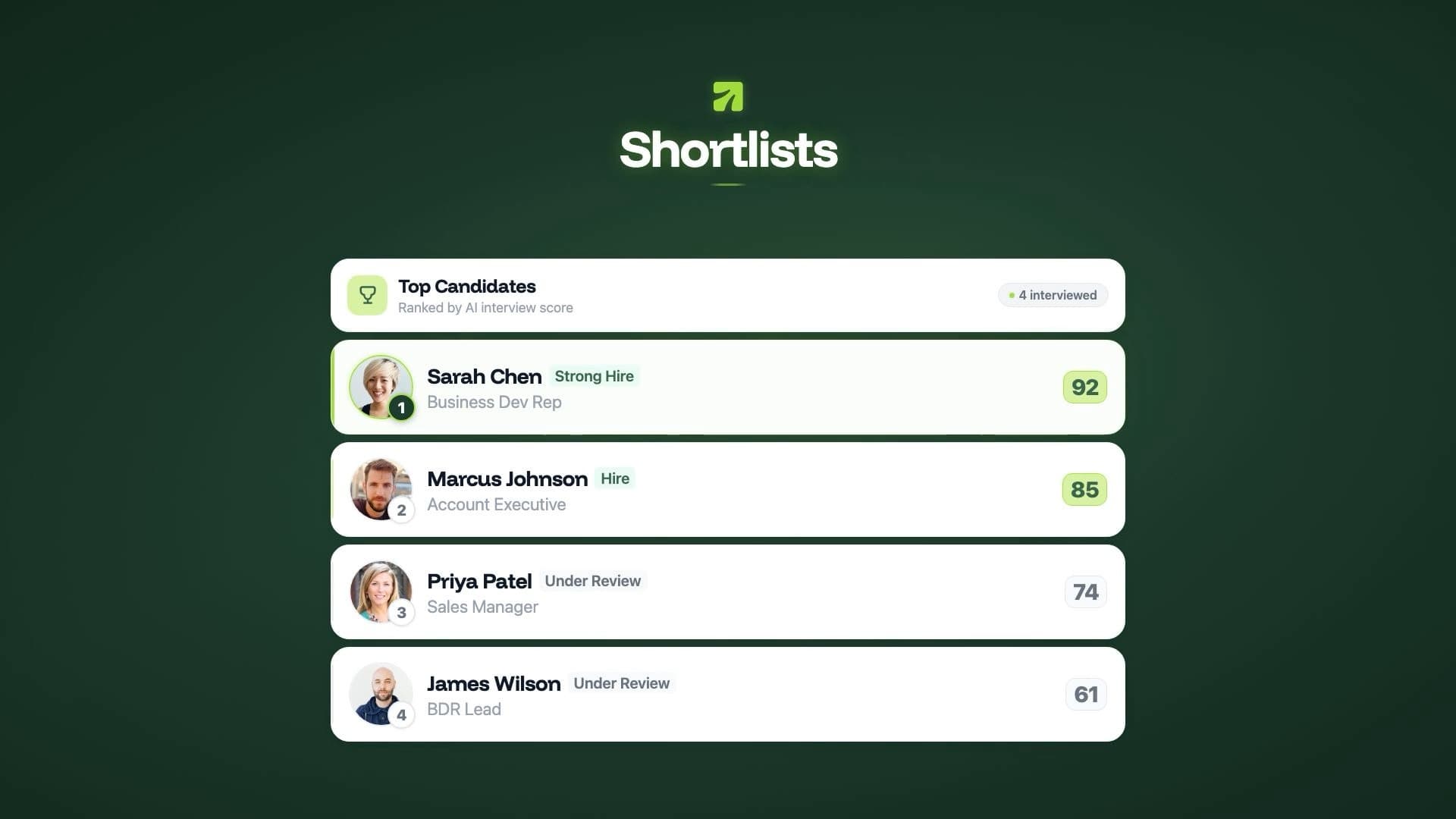
TalentSprout's ranked shortlist — candidates scored 0–100 with color-coded badges so recruiters see the best fits first.
What Most Lists Get Wrong
Why the top-ranking “best staffing tools” articles are misleading — and what to look for instead.
They Confuse ATS with “Staffing Software”
Eight of the top ten results for “best staffing software” are ATS listicles wearing a different title. They review Bullhorn, Zoho Recruit, and Manatal — all applicant tracking systems — and call the article “best staffing tools.” That's like reviewing monitors and calling the article “best computers.” An ATS is one component of a staffing agency's technology stack, not the entire thing.
They Ignore AI Screening Entirely
Of the top ten SERP results for “staffing software,” zero dedicate a section to AI candidate screening as its own category. This is the fastest-growing segment of staffing technology — agencies using AI screening report 50–70% time savings on first-round evaluation. Yet the guides that claim to cover “everything you need” don't even list it as a category. For a detailed comparison of AI interview platforms, see our HireVue alternatives guide.
They Don't Address Integration
Tools that don't connect create double-entry, data silos, and broken workflows. The best staffing technology decision isn't “which ATS is best?” — it's “which combination of tools works together and covers my workflow end-to-end?” Look for native integrations, webhook support, API access, and embeddable components. If data has to be manually re-entered between systems, you'll spend the time you saved on AI screening doing copy-paste between tabs.

From the founder
“We built TalentSprout to be one layer in a connected stack — not a walled garden. Our Zoho Recruit integration, webhook events, and embed capability exist because screening data is useless if it doesn't flow back to where recruiters actually work. The agencies getting the most value aren't the ones with the most tools — they're the ones whose tools talk to each other.”
Frequently Asked Questions
Common questions about staffing tools, pricing, integrations, and AI screening
Most staffing agencies use a combination of tools: an applicant tracking system (ATS) like Bullhorn or Zoho Recruit for managing candidates and job orders, a CRM for client relationships and business development, AI screening tools like TalentSprout for automated candidate evaluation, payroll software for contractor pay processing, and communication platforms for candidate engagement. The specific combination depends on agency size, specialization, and hiring volume.
An ATS (Applicant Tracking System) manages the candidate pipeline — job postings, applications, resume storage, interview scheduling, and placements. A CRM (Candidate Relationship Management) manages long-term talent relationships and client business development — tracking sourced candidates over time, nurturing passive talent pools, and managing client accounts. Many modern staffing platforms combine both, but they serve different purposes: ATS is for active hiring workflows, CRM is for relationship building.
Pricing varies widely by category. ATS platforms range from free (Zoho Recruit Free) to $170+/user/month (Bullhorn). AI screening tools like TalentSprout start at $199/month for up to 100 interviews. Payroll solutions are typically usage-based at $2–$6 per employee per pay period. Most agencies spend $300–$1,500/month total across their core tech stack, depending on team size and hiring volume.
AI can automate the initial screening steps — resume evaluation, pre-screening questionnaires, and first-round interviews — but it works best alongside recruiters, not as a replacement. Tools like TalentSprout handle the repetitive screening loop (reviewing resumes, conducting initial interviews, generating scorecards), which frees recruiters to focus on candidate relationships, client management, and closing placements. Agencies using AI screening typically report 50–70% time savings on first-round evaluation.
Essential integrations include: ATS connectivity (Zoho Recruit, Bullhorn, JobAdder) for syncing candidate data, job board integrations for posting and sourcing, calendar and email integration for scheduling, webhook support for real-time event notifications, and embeddable widgets for career pages. API access is also important for custom workflows. The goal is a connected tech stack where data flows automatically between tools without manual re-entry.
Continue reading
AI Candidate Screening: The Complete Guide
The definitive guide for recruiters and staffing agencies
7 Best HireVue Alternatives
AI interview platforms compared for 2026
AI Resume Screening: How It Works
How pre-screening filters candidates before the interview
40+ Strategic Interview Questions
Field-tested questions with scoring tips