

Bullhorn Alternatives at a Glance
If you are evaluating Bullhorn competitors for your staffing agency, here is the quick comparison. Scroll down for detailed breakdowns of each Bullhorn alternative, a full feature matrix, transparent pricing, and a 30-day migration plan.
| # | Tool | Best for | Starting price |
|---|---|---|---|
| 1 | TalentSprout | Best for staffing agencies that screen at volume | From $199/mo |
| 2 | Recruiterflow | Best for sequence-heavy outbound agency teams | Custom (demo) |
| 3 | Ceipal | Best for mid-market IT staffing with VMS needs | Custom (demo) |
| 4 | JobDiva | Best for high-volume IT and contract staffing | Custom (demo) |
| 5 | Crelate | Best for executive search and retained search | $119/user/mo |
| 6 | Manatal | Best for budget-conscious boutique agencies | $15/user/mo |
| 7 | Zoho Recruit | Best for agencies already on the Zoho suite | $30/user/mo |
| 8 | Loxo | Best for sourcing-heavy agencies that want a single record | Custom (demo) |
Published prices scraped on . See §7 for per-row pricing sources.
Why Agencies Are Looking for Bullhorn Competitors
Bullhorn is the default ATS for a huge chunk of the staffing industry — over 10,000 agencies, and the biggest installed base in North America. It earned that position with a deep staffing-specific feature set, strong VMS integrations for contract business, and an ecosystem of add-ons that cover most of the operational surface. Most agencies did not pick Bullhorn; they inherited it when they grew past two recruiters, and it worked.
The reason Bullhorn alternatives have become a live conversation in 2026 is not that Bullhorn stopped working. It is that the economics of the relationship have drifted. Renewal pricing climbs every year — most agencies we talk to report 10–30% annual increases — and features that used to ship in the core platform have been unbundled into paid add-ons: Bullhorn Automation, Bullhorn Analytics, and VMS Sync are the three that come up most often. The all-in number on a ten-seat agency quietly grows past $25,000 a year before anyone notices.
The second pressure is the interface. Bullhorn works, but the modern recruiter muscle memory — kanban pipelines, embedded email, one-click LinkedIn sourcing, AI-summarized notes — is faster on almost every newer Bullhorn competitor. Junior recruiters in particular benchmark Bullhorn against their last CRM and notice the gap. That is before you touch the third pressure, which is the performance question on larger databases once an agency crosses five years and a hundred thousand candidate records.
None of that makes Bullhorn the wrong answer. It makes Bullhorn alternatives the right question for a specific set of agencies: ones where renewal cost is biting, ones where recruiter throughput is flatlining, and ones where the next feature they actually need is AI screening rather than one more reporting add-on. That is who this guide is for.
The 5 complaints that drive agencies off Bullhorn
- Annual renewal increases — most agencies report 10–30% year-over-year price hikes, with limited leverage to push back on multi-year contracts.
- Aging user interface — recruiter muscle memory has moved on to kanban, embedded email, and one-click sourcing that newer Bullhorn competitors ship by default.
- Performance on large databases — list loads and search slow down noticeably as candidate records climb past the mid six figures.
- Pay-to-play add-ons — Automation, Analytics, and VMS Sync were once core; today they are separate line items that push the effective per-user price up.
- Support response times — anything below the top contract tier routinely reports multi-day response windows on real production issues.
How We Evaluated These Bullhorn Alternatives
Every Bullhorn competitor on this list was scored against the same eight dimensions — the ones that actually predict whether a staffing agency will still be using the tool 24 months in. Pricing was pulled directly from each vendor's public pricing page on ; where pricing is no longer published, the row is labelled Custom (demo) rather than guessed.
- Pricing transparency — Is the starting price published on the vendor site?
- Staffing-specific features — VMS, back-office, perm vs. contract workflows.
- AI capabilities — Resume parsing, matching, and AI screening depth.
- Integrations depth — Email, calendar, LinkedIn, VMS, and job boards.
- Time to value — How long before recruiter 1 is productive on it.
- Agency economics — Multi-seat cost, per-placement cost of ownership.
- Migration effort off Bullhorn — Custom fields, VMS reconnects, data model fit.
- Reviews and durability — G2/Capterra signal, and whether the vendor is still shipping.
The 8 Best Bullhorn Alternatives, Ranked
1. TalentSprout
Best for staffing agencies that screen at volumeFrom $199/mo
Full disclosure: TalentSprout is our product. We have included ourselves because we genuinely compete on price and features, but we have been honest about our limitations below.
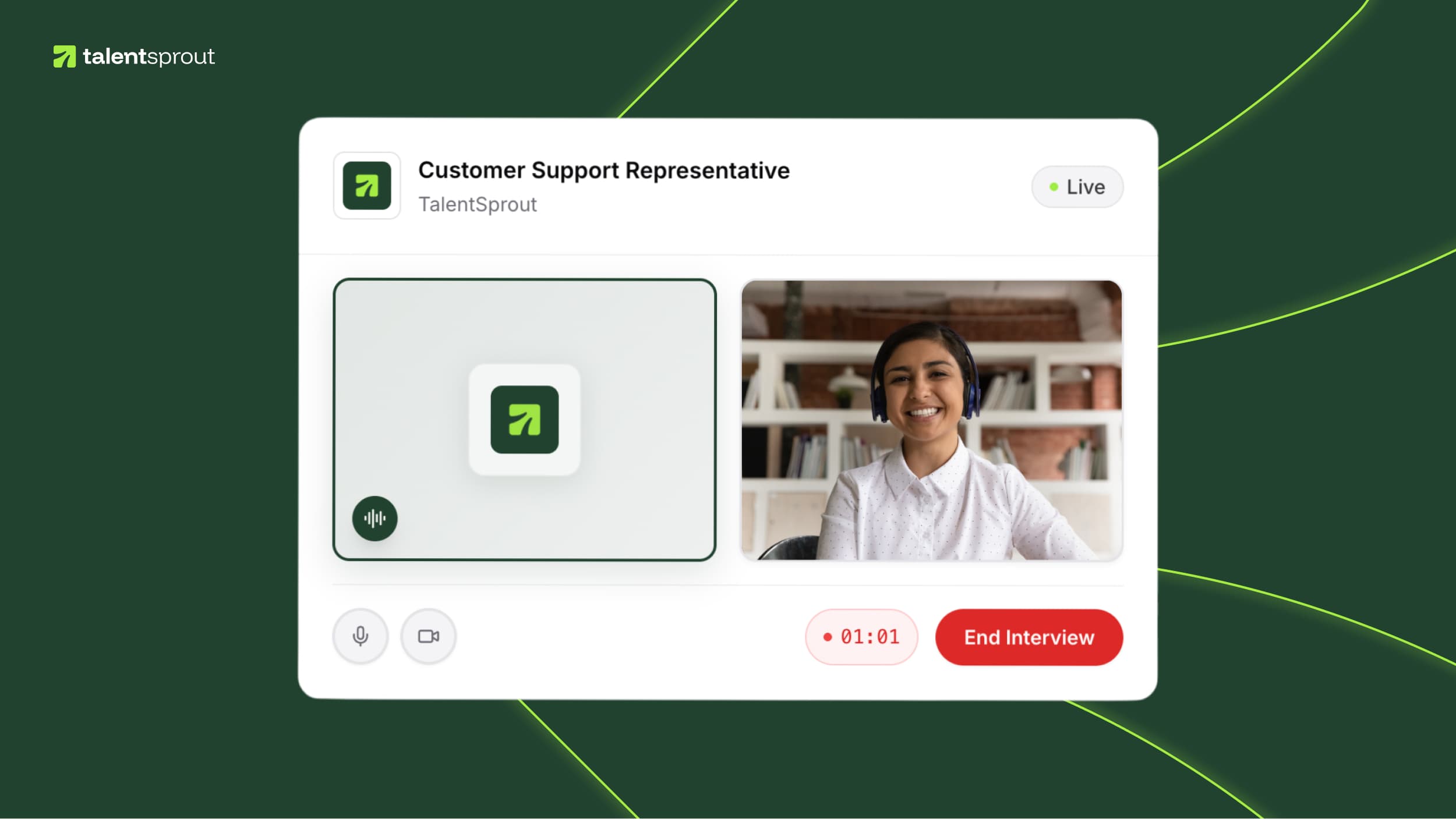
TalentSprout is an AI candidate screening platform built specifically for staffing agencies. Rather than replace Bullhorn, most agencies keep Bullhorn as the system of record and add TalentSprout on top — the Bullhorn integration pushes scored shortlists and evidence summaries back into the candidate record so recruiters never leave their ATS.
The mechanic that matters for staffing agencies is the dynamic, conversational AI interview — follow-up questions, 50+ language support, and a scored shortlist with evidence summaries that recruiters can forward directly to clients. In one real-world agency pilot, a global staffing team screened 140 candidates across 7 roles in 4 weeks, with shortlist quality improving weekly (16% → 38% → 43%). That is the number most agencies evaluating Bullhorn alternatives are trying to move.
Pricing is transparent — see the pricing page for current plans. There is no implementation fee, no annual contract requirement, and a self-serve setup path, which is the opposite of the Bullhorn procurement motion.
- AI voice interviews with scored shortlists
- Native Bullhorn + Zoho Recruit integrations
- Transparent pricing, no implementation fee
- 50+ languages, white-label candidate flow
- —Not a full ATS — pairs with Bullhorn, does not replace it
- —Newer platform — smaller customer base than Bullhorn itself
2. Recruiterflow
Best for sequence-heavy outbound agency teamsCustom (demo) (source: recruiterflow.com/pricing, scraped 2026-04-19 — public pricing no longer listed)
Recruiterflow is the Bullhorn alternative most staffing agencies short-list first in 2026, and for good reason. It was built outbound-first — sequence-heavy email outreach, a strong Chrome extension for LinkedIn, and native texting and calling — which is the exact shape of the modern agency recruiter day. For agencies where recruiters live in sequences rather than lists, it is a measurably better tool than Bullhorn or any of the older Bullhorn competitors.
Note that Recruiterflow removed per-seat pricing from their public site in the last year; the current Platform and AIRA plans are quote-only. The historical starting price was around $99 per user per month, but no public number survives the scrape date, so the row stays Custom (demo).
- Sequence-first outbound workflows
- Excellent Chrome extension for LinkedIn
- Native texting and calling built in
- —Public pricing retreated behind a demo gate
- —Lighter on contract/VMS than Bullhorn
3. Ceipal
Best for mid-market IT staffing with VMS needsCustom (demo) (source: ceipal.com/pricing, scraped 2026-04-19 — pricing page now demo-gated)
Ceipal is one of the two staffing-native Bullhorn alternatives that treat VMS portals as a first-class surface — IT staffing, contract heavy, VMS first — with a lower enterprise price point than JobDiva and an integrated ATS/VMS/back-office stack. The AI job matching layer (Ceipal ATS Apex) is solid, and the VMS connector count is one of the widest in the Bullhorn competitor set.
Ceipal used to publish per-seat pricing; as of the scrape date above, their pricing page is fully demo-gated. That is honest to call out — several Bullhorn competitors have retreated from public pricing in the last 12 months, and Ceipal is one of them.
- Integrated ATS + VMS + workforce stack
- Dozens of VMS connectors available
- AI matching tuned for IT staffing
- —Pricing page demo-gated, no public starting price
- —UI density can be a learning curve
4. JobDiva
Best for high-volume IT and contract staffingCustom (demo)
JobDiva is the Bullhorn alternative most frequently chosen by large IT and contract staffing firms. Its patented resume harvesting engine and VMS Sync module are purpose-built for the MSP / VMS economy, and the platform bundles time-capture, expense, and back-office modules that most Bullhorn competitors leave to add-ons.
Pricing is quote-based — expect an enterprise sales cycle. The payoff is that for the right agency model (high-volume contract, lots of VMS portals, a real back-office burden), JobDiva is one of the few Bullhorn alternatives that removes work from the recruiter day rather than adding it.
- Patented resume harvesting
- Strong VMS Sync and back-office modules
- Purpose-built for IT / contract staffing
- —Quote-based pricing, no self-serve path
- —Overkill for perm-only agencies under 15 seats
5. Crelate
Best for executive search and retained search$119/user/mo (source: crelate.com/pricing, scraped 2026-04-19)
Crelate is the Bullhorn alternative most often picked by boutique executive and retained search firms. Visual kanban pipelines, strong Outlook and Gmail add-ins, built-in email sequencing, and reference/skill tracking make it a better day-to-day for search work than Bullhorn, with a notably friendlier support reputation.
The Business plan is $119 per user per month billed annually. That is a step up from the boutique-budget end of this list, but Crelate earns it on the search-specific workflows and on a better pipeline UX for recruiters who live in deal boards rather than list views.
- Pipeline-first UX built for search
- Strong Outlook/Gmail add-ins
- Good support reputation in G2 reviews
- —$119/user/mo — mid-market, not budget
- —Light on contract staffing features
6. Manatal
Best for budget-conscious boutique agencies$15/user/mo (source: manatal.com/pricing, scraped 2026-04-19)
Manatal is the cheapest serious Bullhorn alternative on the market. At $15 per user per month on the Professional plan (billed annually), a ten-recruiter agency pays $1,800 a year — less than what most Bullhorn agencies pay for a single seat. The product is a general-purpose ATS with AI candidate recommendations, resume parsing, a LinkedIn Chrome extension, and built-in email sequences.
The trade-off is staffing depth. Manatal is excellent for boutique perm agencies up to about 15 recruiters, but it is a general-purpose ATS first and a staffing tool second. It is not the right fit for contract staffing with VMS integrations, and it does not have the back-office modules larger agencies rely on. For the lean perm agency that cares more about cost per seat than staffing-native workflows, it is a near-perfect Bullhorn competitor.
- $15/user/mo — dramatically cheaper than Bullhorn
- Clean, modern UI with kanban pipelines
- Self-serve free trial, no implementation
- —General-purpose ATS, not staffing-native
- —Limited for contract staffing and VMS workflows
7. Zoho Recruit
Best for agencies already on the Zoho suite$30/user/mo (source: zoho.com/recruit/pricing.html, scraped 2026-04-19)
Zoho Recruit runs two separate editions — Corporate HR and Staffing Agency — and for Bullhorn alternatives the staffing edition is the interesting one. It covers candidates, contacts, clients, job orders, and placements in a single data model and integrates natively with the rest of the Zoho universe (CRM, Books, Mail, Sign). Corporate Standard is $30 per user per month billed annually.
The pitch is ecosystem economics, not staffing depth. If your agency already runs on Zoho CRM or Zoho Books, Zoho Recruit collapses three tools into one vendor relationship and one data model. Outside of that footprint the case is weaker — depth per feature is shallower than the staffing specialists above, and the UI is configuration-heavy. But for an SMB agency already inside the Zoho footprint, it is the most obvious Bullhorn competitor to evaluate first.
- Dedicated Staffing Agency edition
- Deep integration with the rest of the Zoho suite
- Forever-free tier for solo recruiters
- —Shallower than staffing-native alternatives
- —Heavy customization required to get to parity
8. Loxo
Best for sourcing-heavy agencies that want a single recordCustom (demo)
Loxo bundles ATS, CRM, and AI sourcing into a single candidate record. For agencies whose bottleneck is sourcing — not screening, not pipeline hygiene — Loxo is often the better-shaped Bullhorn alternative, because it removes a whole sourcing tool from the stack rather than sitting beside one.
Pricing is quote-based and tends to land in the mid- market range. The trade-off is that where Loxo shines on sourcing, it is lighter than JobDiva or Ceipal on VMS and back-office — so it is a strong answer for some agency models and the wrong answer for others.
- AI sourcing on a 1.2B+ profile graph
- ATS + CRM + sourcing on one record
- Native email, texting, calling
- —Quote-based, no public pricing
- —Thin on VMS / contract workflows
Full Bullhorn Competitors Feature Matrix
Side-by-side comparison of all 8 Bullhorn alternatives across the dimensions that actually matter for staffing agencies. Bullhorn itself is included in the first column as the baseline.
| Feature | Bullhorn | TalentSprout | Recruiterflow | Ceipal | JobDiva | Crelate | Manatal | Zoho Recruit | Loxo |
|---|---|---|---|---|---|---|---|---|---|
| Published starting price | Custom | — | Custom | Custom | Custom | $119/user/mo | $15/user/mo | $30/user/mo | Custom |
| AI screening (voice/video) | Add-on | Yes (core) | No | No | No | No | No | No | No |
| AI resume matching | Add-on | Yes | Yes | Yes | Yes | Partial | Yes | Yes | Yes |
| VMS / contract staffing | Strong (add-on) | Via ATS | Limited | Strong | Strong | Limited | Limited | Limited | Limited |
| Back-office modules | Add-on | No | No | Yes | Yes | No | No | Partial | No |
| Self-serve setup | No | Yes | No | No | No | Yes | Yes | Yes | No |
| Bullhorn integration | — | Yes | Partial | Partial | No | No | No | No | No |
| Agency model fit | All | Screening layer | Outbound / agency | IT / contract | IT / contract | Search / retained | Perm, boutique | Zoho shops | Sourcing-heavy |
Horizontal scroll on mobile; the feature column is sticky for keyboard and touch users. Published prices (Manatal $15/user/mo, Zoho Recruit $30/user/mo, Crelate $119/user/mo) scraped on ; see §7 for sources.
How to Migrate from Bullhorn in 30 Days
Every agency migration off Bullhorn that works follows roughly the same 30-day shape. The below is the condensed version — the full playbook lives in our staffing automation guide.
Days 1–7: Audit and export everything out of Bullhorn
Export every active candidate, contact, company, job, placement, and note out of Bullhorn into CSVs. Pull your last 12 months of activity logs. Map custom fields against the target system's schema and flag any field that does not have a clean one-to-one home. Most migrations fail on custom fields, not on core records, so this is where to slow down.
Days 8–14: Clean, dedupe, and map the data
Run deduplication on candidates by email and phone, normalize company names, and collapse duplicate contacts. Decide which custom fields survive the migration and which are quietly retired. Build the mapping spreadsheet that will drive the import — one row per source field, one row per target field, with the transformation rule beside each.
Days 15–21: Import into the new ATS and rebuild integrations
Run a staged import — candidates first, then contacts and companies, then jobs, then placements, then activities. Reconnect your email, calendar, LinkedIn extension, and job-board integrations. Wire the new system into your VMS portals if you run contract business. Smoke-test with two recruiters on live roles for at least three days before cutting over the rest of the team.
Days 22–30: Cutover, train, and decommission Bullhorn
Freeze writes in Bullhorn, run one final delta export, load the delta into the new system, and flip the team over. Keep Bullhorn read-only for 90 days as your audit trail. Run two training sessions — one on the new workflows, one on reporting — and capture the top 20 recruiter questions in an internal FAQ so you are not answering them forever.
Bullhorn Alternatives Pricing Compared
Bullhorn does not publish pricing. Neither does five of the eight Bullhorn competitors in this guide. That is the real pricing story in 2026 — the staffing ATS market has quietly retreated behind demo gates, which makes the rows that do publish (Manatal, Zoho Recruit, Crelate) the cleanest benchmark you can get.
The table below lists starting prices scraped directly from each vendor's public pricing page on . Year-one cost is modelled for a ten-seat agency, billed annually, before any implementation fees or add-ons.
| Tool | Starting price | Pricing model | Year 1 (10 seats) |
|---|---|---|---|
| TalentSprout | From $199/mo | Per-account monthly, no per-seat cost | $2,388 |
| Recruiterflow | Custom (demo)source: recruiterflow.com/pricing, scraped 2026-04-19 | Quote-based; public pricing no longer published | Custom quote |
| Ceipal | Custom (demo)source: www.ceipal.com/pricing/, scraped 2026-04-19 | Quote-based; pricing page now demo-gated | Custom quote |
| JobDiva | Custom (demo) | Annual contract, quote-based | Custom quote |
| Crelate | $119/user/mosource: www.crelate.com/pricing, scraped 2026-04-19 | Per-seat monthly, billed annually (Business) | $14,280 |
| Manatal | $15/user/mosource: www.manatal.com/pricing, scraped 2026-04-19 | Per-seat monthly, billed annually (Professional) | $1,800 |
| Zoho Recruit | $30/user/mosource: www.zoho.com/recruit/pricing.html, scraped 2026-04-19 | Per-seat monthly, billed annually (Corporate Standard) | $3,600 |
| Loxo | Custom (demo) | Annual contract, quote-based | Custom quote |
The hidden line items to ask about
- Implementation — Bullhorn and the enterprise Bullhorn alternatives (JobDiva, Ceipal) typically add $5,000–$25,000 in one-time setup. Self-serve tools (Manatal, Zoho Recruit, Crelate, TalentSprout) charge $0.
- Add-on modules — Automation, Analytics, and VMS Sync on Bullhorn; texting, calling, and assessments on several Bullhorn competitors. Ask for the all-in three-year cost, not the per-seat sticker.
- Annual uplift — most Bullhorn renewal quotes include an automatic 10–15% uplift clause. Ask for a capped uplift in year two and three before signing anything.
Rule of thumb: the sticker price is usually 60–70% of the real all-in cost.
How to Choose the Right Bullhorn Alternative
Every agency decision between Bullhorn competitors comes down to three questions, in this order. Answer them before you take your first demo.
1. What is your agency model?
Perm, contract, executive search, or RPO? That answer kills half the list. Perm-only boutique agencies should be looking at Manatal, Zoho Recruit, or Crelate. Contract-heavy IT staffing with VMS portals needs JobDiva or Ceipal. Executive search lives on Crelate or Loxo. RPO work that requires multi-client branding benefits most from keeping Bullhorn and layering AI screening on top.
2. How many seats and at what all-in cost?
Multiply the per-seat price by your recruiter count, add 20–40% for add-ons, and compare that number against your current Bullhorn spend. Manatal at $15/user/mo is a different conversation than Crelate at $119/user/mo when you hit ten seats. The other direction matters too — below five seats, most enterprise Bullhorn alternatives are overbuilt for what you need.
3. Where is your time actually going?
If the recruiter day is 40% phone screens, fix that before you fix the ATS — add AI screening on top of Bullhorn and you will reclaim 20+ hours per recruiter per month without a migration. If the recruiter day is 40% sourcing, Loxo matters more than whichever Bullhorn competitor has the prettier pipeline UI. The ATS is rarely the bottleneck. It is usually the scapegoat.
Red flags in any Bullhorn competitor demo
- No published pricing and no willingness to send a full price list in email before the call.
- No self-serve trial path — if the vendor is unwilling to let you touch the product, they are probably compensating for something.
- Multi-year contract requirement without a capped year-over-year uplift.
- No customer reference in your specific model (perm, contract, search, RPO) inside 24 hours.
- Vague answers on how candidate and activity data will migrate out if you ever want to leave.
Frequently Asked Questions
Common questions about Bullhorn alternatives and migrating off Bullhorn
The best Bullhorn alternative depends on what you actually need. For staffing agencies that screen a high volume of candidates, TalentSprout pairs with any ATS and replaces the slowest part of the recruiting workflow — phone screens — with AI voice interviews and scored shortlists. For agencies that want to replace Bullhorn outright, Manatal ($15/user/mo) wins on price, JobDiva wins on IT and contract volume, and Crelate wins on executive search. There is no single best Bullhorn alternative; there is the right Bullhorn competitor for your model, your size, and your budget.
Bullhorn does not publish pricing. Most agencies report paying between $99 and $149 per user per month on annual contracts, with additional fees for Bullhorn Automation, Analytics, and VMS Sync. Published Bullhorn competitors run the full range in 2026: Manatal at $15/user/mo, Zoho Recruit at $30/user/mo, Crelate at $119/user/mo, with Ceipal, Recruiterflow, JobDiva, and Loxo all quote-based. That is the real pricing story — only three of the eight major Bullhorn alternatives publish a starting price at all.
Yes, but migrating to any of the major Bullhorn alternatives is a 30-day project with real risk if you rush it. The 30-day migration framework in this guide (export, clean, stage, cut over) is how most staffing agencies move without losing candidates or activity history. The hardest part is almost never the core data — it is the custom fields, the integrations, and the recruiter muscle memory. Plan for a two-week overlap where Bullhorn stays read-only, budget a week of reduced throughput during cutover, and do not migrate during your busiest month.
AI depth varies dramatically across Bullhorn competitors. Manatal and Zoho Recruit offer AI candidate recommendations and resume parsing. JobDiva and Ceipal have AI-assisted matching tuned for IT staffing. Loxo leans on AI sourcing against its profile graph. For the specific job of screening candidates with AI voice interviews and producing scored shortlists, TalentSprout is the purpose-built layer that works alongside any of these — most staffing agencies keep their ATS and add AI screening on top rather than replacing both at once.
The five complaints that come up in almost every Bullhorn alternatives conversation are: (1) price increases at renewal, often 10–30% a year; (2) a user interface that has not meaningfully changed in a decade; (3) performance lag on larger databases; (4) pay-to-play add-ons — Automation, Analytics, VMS Sync — that were once core features; and (5) support response times that stretch into days on anything below the top contract tier. Agencies leaving Bullhorn for staffing agencies are usually not chasing a new feature. They are leaving friction.
Yes, and for many staffing agencies this is the right first move. TalentSprout integrates with Bullhorn so candidates get screened with AI voice interviews, scored, and ranked — then the shortlist flows back into Bullhorn as a normal candidate activity. You get the economic benefit of AI screening without ripping out your system of record, your VMS integrations, or your historical placement data. Most agencies that eventually migrate off Bullhorn do this hybrid setup for 6–12 months first.
Use a three-question decision framework to narrow the Bullhorn alternatives shortlist. First, what is your staffing agency model — perm, contract, executive search, or RPO? That dictates whether you need VMS integration, back-office modules, or a pipeline-heavy recruiting CRM. Second, how many seats do you actually need? Manatal at $15/user/mo is a different math problem than Crelate at $119/user/mo when you multiply by ten recruiters. Third, where is your time actually going? If phone screening is the bottleneck, fix that first with AI screening. If sourcing is the bottleneck, a Loxo-style tool matters more than a prettier staffing ATS.
Keep Bullhorn. Add AI screening on top.
The fastest way to test whether a Bullhorn alternative is even worth the migration is to fix the recruiter bottleneck first — phone screens — and see what happens to throughput. TalentSprout integrates with Bullhorn, runs AI voice interviews, and pushes scored shortlists back into the candidate record.
Continue reading
Best HireVue Alternatives (2026)
The sister comparison — AI video interview platforms vs. HireVue
8 Best AI Interviewing Tools (2026)
The AI screening layer that sits on top of any ATS
Staffing Software: What Modern Agencies Need
The complete staffing tech stack guide for 2026
TalentSprout + Bullhorn Integration
Keep Bullhorn, add AI screening on top